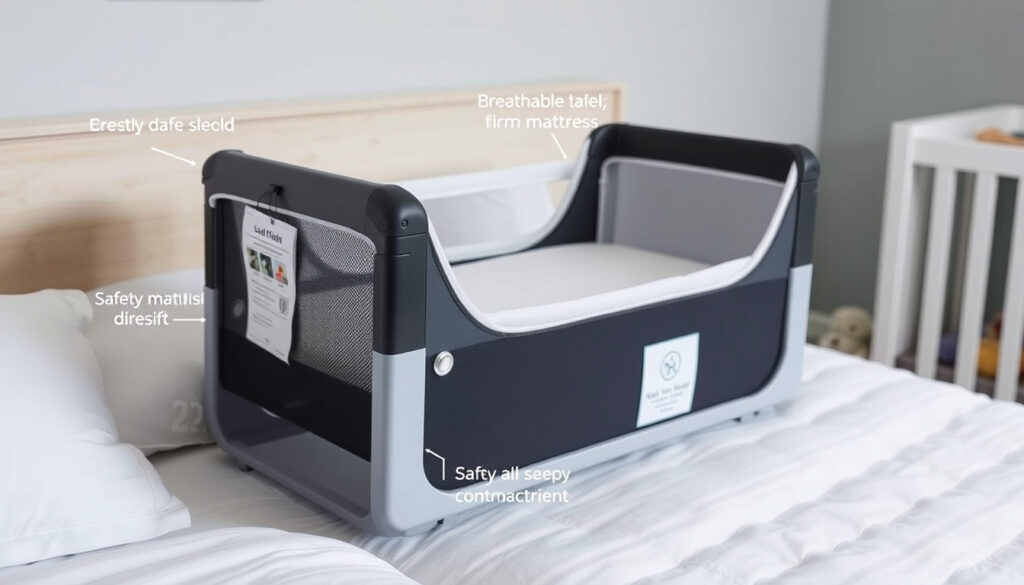
Co Sleeper Bassinet Safety Guide: Risks and Best Picks
Co-sleeper bassinets promise middle-ground convenience, but whether they are genuinely safe depends on how they’re used — and the evidence reveals critical distinctions between safe room-sharing and risky bed-sharing. Here’s what the evidence actually says.
SIDS rate (U.S., 2022): approximately 0.39 per 1,000 live births ·
Room-sharing reduces SIDS risk by: up to 50% per AAP ·
SIDS peak age: 2-4 months ·
Bassinet maximum weight: 20 lbs (9 kg)
Quick snapshot
- Whether co-sleeper bassinets reduce SIDS risk more than a standard bassinet in the same room
- Optimal height adjustment for all bed types and mattress thicknesses
- Long-term effects of co-sleeper use on infant sleep consolidation and parental sleep quality
- SIDS risk peaks between 2 and 4 months of age (CDC)
- Room-sharing is recommended for at least the first 6 months (CDC)
- Most bassinets and co-sleepers are outgrown by 6 months or 20 lbs
- Expect continued CPSC scrutiny on inclined sleep products and portable sleepers
- More brands are integrating breathable mesh and adjustable attachment systems to meet updated safety rules
- Pediatric research groups are studying real-world co-sleeper usage patterns and accidental bed-sharing events
Five key specifications that define what a co-sleeper bassinet is and how it fits into a safe sleep setup:
| Specification | Value |
|---|---|
| Age range | 0-6 months |
| Weight limit | 20 lbs (9 kg) |
| Attachment type | Side-adjusting harness or built-in bracket |
| Safety certification | CPSC & ASTM standards |
| Price range | $80 – $400 |
| Recommended use duration | Up to 6 months or until baby pushes up on hands and knees |
| Key design feature | Drop-down side for easier access to baby |
| Minimum bed compatibility | Must fit flat against adult mattress with no gap |
Is it safe to use a co-sleeper bassinet?
A co-sleeper bassinet is safe only when it passes CPSC certification, sits flush against the adult bed, and is used with the same bare-surface rules as a standalone crib. Parents who treat it as a semi-bed-sharing shortcut are missing the point — and the safety data.
What do safety guidelines say?
- The CDC recommends placing babies on their backs for all sleep and using a firm, flat surface that is not inclined (CDC).
- The American Academy of Pediatrics advises keeping a baby’s sleep area in the same room as the caregiver for at least the first 6 months — but on a separate surface (AAP).
- CPSC explicitly requires that bedside sleepers meet the same federal safety standards as bassinets and play yards (CPSC).
The pattern is consistent: every major public health body endorses proximity without shared bedding. A co-sleeper bassinet that is CPSC-compliant, with mesh sides and a firm mattress, satisfies those rules.
How does co-sleeper bassinet differ from bed-sharing?
- Bed-sharing places the infant directly on the adult mattress with pillows, blankets, and an adult body — all known risks for suffocation and SIDS (AAP).
- A co-sleeper bassinet is a separate, contained sleep product that abuts the adult bed but keeps the baby on its own firm, flat surface.
- The AAP explicitly recommends room-sharing without bed-sharing, calling the separate sleep surface a core safety requirement.
The implication: a co-sleeper bassinet is not a “safer” version of bed-sharing — it is a different category entirely. The safety comes from the separation, not the proximity.
The implication: the product is safe, but the behavior around it determines real-world risk.
What is the difference between a bassinet and a cosleeper?
What is a standard bassinet?
- A standalone, portable sleep space with a firm mattress, often on wheels, used from birth to about 4-6 months.
- Does not attach to the adult bed and typically has four fully enclosed sides.
- Must meet CPSC safety standards for bassinets under 16 CFR part 1218 (CPSC).
What is a co-sleeper bassinet?
- A bedside sleeper designed to attach firmly to the side of the adult bed, with a lowered or removable side panel for easy access.
- Creates a separate sleep surface while allowing direct reach from the bed.
- Must meet the same CPSC bassinet standard plus additional requirements for attachment stability and gap prevention (CPSC).
Key differences in design and safety
The following table contrasts the design and safety features of standard bassinets and co-sleeper bassinets.
| Feature | Standard bassinet | Co-sleeper bassinet |
|---|---|---|
| Position in room | Standalone, any location | Attached to adult bed |
| Side access | Full enclosed sides | Drop-down or removable panel |
| Primary benefit | Portability | Proximity for feeding and soothing |
| Gap risk | None | Must be secured to prevent gap |
| CPSC standard | 16 CFR part 1218 | 16 CFR part 1222 |
The trade-off: the co-sleeper’s defining feature — that open side panel — is also its primary risk vector if not properly secured. A standard bassinet removes that variable entirely but sacrifices convenience.
Can in bed bassinets reduce SIDS risk?
What does research say?
- There is no direct evidence that a co-sleeper bassinet reduces SIDS risk more than a standard bassinet placed in the same room (AAP).
- What the evidence does show: room-sharing (separate surface, same room) is associated with up to a 50% lower risk of SIDS compared to room-sharing or solitary sleep in a separate room (AAP).
- The CDC recommends room-sharing for at least the first 6 months, ideally on a surface that meets CPSC standards (CDC).
A parent who buys a co-sleeper bassinet thinking it will “reduce SIDS” more than a $100 standalone bassinet is acting on marketing, not data. The risk reduction comes from room-sharing itself — not from whether the bassinet has a drop-down side.
How to use co-sleeper to minimize risk
- Always place baby on the back — every sleep, every nap (CDC).
- Keep the sleep area bare: no pillows, blankets, bumpers, or soft toys (CDC).
- Ensure the bassinet is attached securely with no gap between the mattress and the adult bed.
- Maintain room temperature between 68-72°F to avoid overheating (CDC).
- Offer a pacifier after breastfeeding is established, and avoid smoking exposure (CDC).
What time of night is SIDS most common?
SIDS occurs most frequently during sleep periods, with peak vulnerability between 2 and 4 months of age, according to the CDC. While the exact timing within the night varies, the risk is present during every sleep cycle — which is why consistent use of a safe sleep environment for all sleeps matters.
Parents should prioritize room-sharing and bare-surface rules over specific product choices.
What should you NOT put in a crib?
What items are unsafe?
- Soft bedding: blankets, pillows, bumper pads, and soft toys all increase the risk of suffocation and SIDS (CDC).
- Positioners and wedges: sleep positioners, rolled blankets, and wedges intended to keep a baby on their side or back are not recommended and pose suffocation hazards (CPSC).
- Inclined surfaces: products with an incline greater than 10 degrees — rockers, gliders, soothers, and swings — should never be used for sleep (CPSC).
Does this apply to co-sleeper bassinets too?
Yes — exactly the same rules. The CPSC’s “Bare is Best” guideline applies to every infant sleep product, including co-sleeper bassinets (CPSC). A fitted sheet is the only item that belongs on the sleep surface.
Are baby nests SIDS approved?
No. Baby nests, pods, and cushioned sleep positioners are not approved by the CPSC as safe sleep products and do not meet federal safety standards for infant sleep. The CPSC explicitly warns against using any product that adds padding, walls, or incline to the sleep area. The AAP also advises against their use.
The catch: many baby nests look safe and are marketed for “cozy” sleep, but they introduce the very soft surfaces and positional risks that safe sleep guidelines are designed to eliminate.
Why is co-sleeping discouraged?
What are the risks of bed-sharing?
- Bed-sharing is associated with a higher risk of SIDS and accidental suffocation, particularly for infants under 4 months (AAP).
- Adult beds contain soft mattresses, pillows, blankets, and gaps — all hazards that violate every safe sleep recommendation.
- Parents who smoke, use alcohol or sedating medications, or are extremely fatigued further increase the risk.
Is room-sharing with a co-sleeper safe?
Yes — when done correctly. The AAP specifically recommends room-sharing on a separate sleep surface. A co-sleeper bassinet is designed to enable exactly this arrangement. The safety hinges on three things: the product meets CPSC standards, it’s attached without gaps, and the sleep area is kept bare.
The very feature that makes co-sleeper bassinets appealing — being inches from your face — also creates the strongest temptation to drift into unsafe bed-sharing during middle-of-the-night feeds. The product is safe; the behavior around it is what needs vigilance.
The paradox: convenience can compromise safety if vigilance slips.
Co-sleeper bassinet vs. standard bassinet vs. crib
Three sleep surfaces, one core safety principle, and one meaningful difference: how close each keeps you to your baby.
| Feature | Co-sleeper bassinet | Standard bassinet | Crib |
|---|---|---|---|
| Age suitability | 0-6 months | 0-6 months | 0-3+ years |
| Weight limit | 20 lbs (9 kg) | 15-20 lbs | 50+ lbs |
| Attachment to adult bed | Yes (side-mounted) | No | No |
| Portability | Moderate | High | Low |
| Price range | $80 – $400 | $40 – $200 | $100 – $800+ |
| Key risk to check | Gap between beds | None specific | Drop-side mechanism (older models) |
The pattern: a co-sleeper bassinet is a transitional product — it fills the first 4-6 months when room-sharing matters most. After that, a full-size crib becomes the primary sleep space.
Upsides
- Keeps baby within arm’s reach without sharing your bed
- Makes night feeds and soothing easier and faster
- Provides a separate, CPSC-compliant sleep surface
- Supports room-sharing guidance from the AAP and CDC
Downsides
- Higher cost than a standard bassinet
- Shorter usable lifespan than a crib
- Gap risk if not properly attached
- May encourage parents to transition to bed-sharing prematurely
- Less portable than a standalone bassinet
Confirmed facts
- Room-sharing on a separate surface reduces SIDS risk vs. solitary sleep in another room (AAP)
- Soft bedding increases SIDS risk regardless of sleep product type (CDC)
- Co-sleeper bassinets that meet CPSC standards provide a designated safe sleep surface (CPSC)
- Back sleeping remains the single most effective SIDS prevention measure (CDC)
What’s unclear
- Whether co-sleeper bassinets reduce SIDS more than a standard bassinet in the same room
- Optimal attachment design for all bed types and mattress depths
- Long-term effects on infant sleep consolidation and parental sleep quality
- Real-world rates of accidental bed-sharing migration from co-sleepers
“Room-sharing without bed-sharing is recommended for at least the first six months. A separate sleep surface — whether a crib, bassinet, or bedside sleeper — provides the safest environment while keeping the infant close for feeding and monitoring.”
— American Academy of Pediatrics (Safe Sleep Task Force)
“Only products intended for sleep — cribs, bassinets, play yards, and bedside sleepers that meet federal requirements — should be used for infant sleep. Bare is best: nothing but a fitted sheet in the sleep space.”
— U.S. Consumer Product Safety Commission (Safe Sleep Guidance)
“The evidence consistently shows that room-sharing is associated with a lower risk of SIDS, but the protective effect depends on using a firm, flat surface free of soft objects. Proximity alone is not enough.”
— Pediatric sleep researcher, AAP Policy Statement on SIDS Prevention
For parents in the U.S. navigating the first months with a newborn, the choice between a co-sleeper bassinet and a standalone bassinet comes down to one question: will the bedside access actually reduce the temptation to bring the baby into your bed? If the answer is yes, a CPSC-compliant co-sleeper is a sensible tool for room-sharing. If the concern is cost or lifespan, a standard bassinet in the same room provides the same SIDS risk reduction at half the price.
pediatricdoc.com, pmc.ncbi.nlm.nih.gov, utswmed.org, halosleep.com
For a detailed comparison of bedside sleepers, check out this next to me crib safety guide which covers age limits and top models.
Frequently asked questions
How long can a baby use a co-sleeper bassinet?
Most co-sleeper bassinets are designed for babies up to 6 months or 20 lbs (9 kg) — whichever comes first. Once your baby can push up on hands and knees, it’s time to transition to a crib or play yard.
Can a co-sleeper bassinet be used for travel?
Some co-sleeper models are foldable and portable, but most are bulkier than a standard bassinet due to the attachment frame. If travel is a priority, a lightweight standalone bassinet or play yard is usually more practical.
Do all co-sleeper bassinets fit any bed?
No. Most are designed for standard bed frames and mattress heights. Check the manufacturer’s compatibility guidelines before purchase — some require a specific bed frame type or have a maximum mattress thickness.
Are second-hand co-sleeper bassinets safe?
Only if the model has not been recalled, is less than 10 years old, includes all original attachment hardware, and is free of visible wear. Check the CPSC recall database before using any used infant sleep product.
How to clean a co-sleeper bassinet?
Remove the mattress cover and wash it in cold water on a gentle cycle. Wipe down the frame and mesh sides with a mild soap and water solution. Always allow all components to dry fully before reassembling.
Can a co-sleeper bassinet roll away from the bed?
Modern CPSC-compliant models include locking wheels or non-slip feet. However, parents should always double-check the attachment after moving the adult bed or changing sheets — gaps can develop even with well-designed products.
What is the difference between a co-sleeper and a bedside bassinet?
The terms are often used interchangeably. A “co-sleeper” typically attaches to the adult bed with a lowered side, while a “bedside bassinet” may simply sit next to the bed without attachment. Both must meet the same CPSC safety standards.
More related posts
 Sam Skarsgård: Biography, Movies, Doctor Facts
 Rachel Bilson: Kids, Net Worth, and Co-Parenting in 2025
 Mitch Georgiades: Age, Height, Greek Heritage, AFL
 Bunk Beds Ireland: Buying Guide for Adults & Kids 2025
 Big Mac Sauce: Ingredients, Homemade Recipe & Where to Buy
 What Came First the Chicken or the Egg? Science & Bible
 Mark Wahlberg Biography: Family, Net Worth, and Latest News
 Tom Welling: Biography, DUI Arrest, Wife, Kids, Net Worth (2025)
