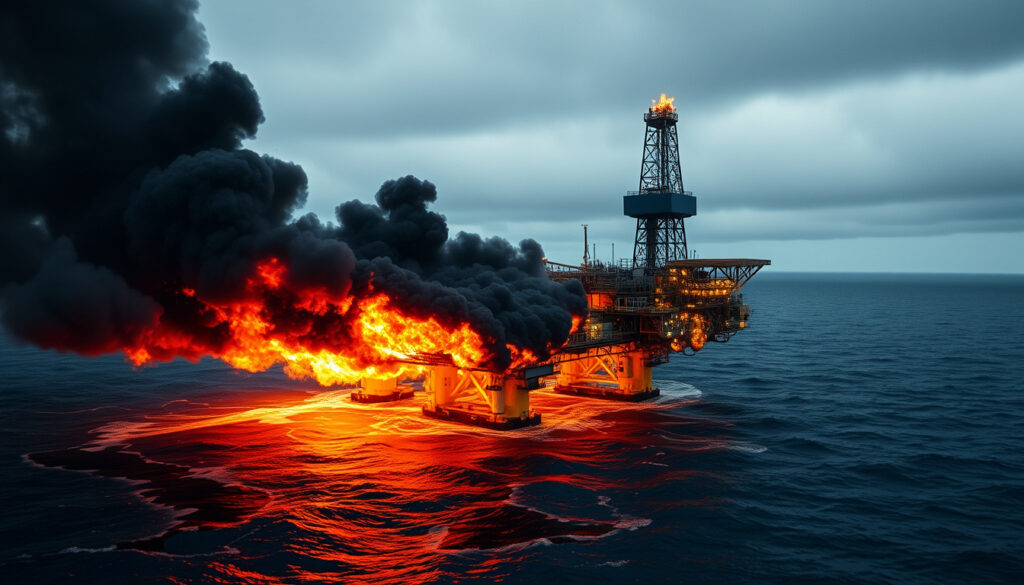
Deepwater Horizon Oil Spill: Fault, Settlements, Status
Fifteen years ago, an explosion killed 11 men and sank a drilling rig in the Gulf of America, releasing an estimated 3.19 million barrels of oil over 87 days. Today, the legal system is still untangling who pays, who goes to jail, and what the spill did to the people and coastline left behind.
Deaths from explosion: 11 ·
Barrels of oil released (est.): 3.19 million ·
Total BP settlement fund: ~$20 billion ·
Date of explosion: April 20, 2010 ·
Criminal charges filed: 4 ·
Worst oil spill in U.S. history: Yes
Quick snapshot
- Explosion on April 20, 2010 (U.S. Department of Justice (2015 settlement announcement))
- 11 workers killed (PBS NewsHour) (U.S. Department of Justice (2015 settlement announcement))
- Worst oil spill in U.S. history (U.S. EPA (2025 status report))
- BP as operator (PBS NewsHour (report))
- Transocean owned the rig (PBS NewsHour) (PBS NewsHour (report))
- Halliburton performed cementing work (PBS NewsHour) (PBS NewsHour (report))
- BP pleaded guilty to criminal charges (U.S. Department of Justice) (NOAA Fisheries (largest environmental settlement))
- Record $20 billion settlement (NOAA Fisheries (largest environmental settlement))
- Four individuals convicted (PBS NewsHour) (NOAA Fisheries (largest environmental settlement))
- Well sealed, no active leak (U.S. EPA) (NOAA Gulf Spill Restoration (2025 annual report))
- Restoration ongoing but stalled by litigation (PBS NewsHour) (NOAA Gulf Spill Restoration (2025 annual report))
- Environmental monitoring continues (NOAA Gulf Spill Restoration (2025 annual report))
Six key facts from the disaster and its aftermath reveal the scale of what happened — and what remains unresolved.
| Fact | Value |
|---|---|
| Date of explosion | April 20, 2010 |
| Deaths | 11 |
| Total oil leaked | 3.19 million barrels (est.) |
| Total fines and penalties | Over $20 billion |
| Criminal convictions | 4 individuals |
| Status of well | Sealed, not leaking |
Who was at fault for Deepwater Horizon?
Multiple investigations — from the U.S. Department of Justice (civil division) to the U.S. EPA (regulatory oversight) — converged on three primary actors. BP, as the Macondo well’s operator and lease holder, bore the majority of legal liability. The company’s decisions around well design and testing were central to the disaster’s root cause. Transocean owned and operated the Deepwater Horizon rig itself, while Halliburton provided and tested the cement job that failed to seal the well.
The implication: BP’s role as both operator and lease holder meant it absorbed roughly 65% of fault in the civil settlement — but Transocean and Halliburton also paid substantial penalties, meaning no single company escaped financial consequence.
Who got the blame for Deepwater Horizon?
Official fault allocations from the U.S. Department of Justice (civil settlement) assigned the largest share to BP, followed by Transocean and Halliburton. The triggering failure — a cement barrier that did not hold — was linked directly to Halliburton’s work.
The trade-off: assigning blame in a disaster with multiple contributing failures means the public rarely sees a single perpetrator. Yet the DOJ’s structured settlement ensured that Gulf states received compensation proportionate to damage caused.
Did anyone go to jail for Deepwater Horizon?
Four individuals received prison sentences. PBS NewsHour (reporting on criminal convictions) confirmed that three BP employees — a former BP executive and two rig supervisors — were convicted of manslaughter or Clean Water Act violations. A fourth individual, a former BP engineer, was convicted of obstructing justice.
The pattern: while the per-incident criminal prosecution rate is low relative to the disaster’s scale, the sentences were among the longest ever imposed for an environmental crime.
How much did BP pay the survivors?
Two separate tracks of compensation existed. The 2012 settlement for ill workers and coastal residents totaled $67 million, according to PBS NewsHour (reporting on settlements). Nearly 80% of those who received payments got no more than about $1,300 each. Separately, a more substantial $20 billion settlement with the U.S. government covered natural resource damages and economic losses for Gulf states, as detailed by the U.S. Department of Justice (settlement announcement).
What this means: individual survivors received relatively small amounts compared to the $20 billion directed toward coastal restoration and economic recovery programs.
15 years after Deepwater Horizon oil spill, lawsuits stall and restoration is…
Roughly 4,800 lawsuits seeking compensation for health problems linked to the spill had been filed by 2025. PBS NewsHour (investigative report) reported that all but a handful were dismissed and only one settled. A 2022 lawsuit by cleanup worker Gremillion was still pending.
On the restoration side, the Deepwater Horizon Trustees (NOAA Gulf Spill Restoration) reported in 2025 that more than $3.34 billion had been allocated to 384 restoration projects, with 286 approved. But a flagship Mississippi River sediment-diversion project in southeast Louisiana — seen by many conservationists as the centerpiece — stalled over concerns about impacts on communities and dolphins, per PBS NewsHour (report).
Is the Deepwater Horizon still leaking?
The Macondo well was declared permanently sealed by September 2010, according to the U.S. EPA (2025 status report). No active leaks from the rig remain. The Deepwater Horizon Trustees (NOAA Gulf Spill Restoration) confirmed ongoing environmental monitoring, with the question of exactly how much oil remains in Gulf sediments still open.
The implication: the well is safe, but the ecosystem’s full recovery timeline remains uncertain because residual oil in sediments continues to pose unknown risks.
What is the true story behind Deepwater Horizon?
The disaster began with a sequence of failures on April 20, 2010. A methane gas bubble escaped from the Macondo well and traveled up the drill pipe, expanding rapidly. At the surface, it ignited, causing an explosion that killed 11 workers, as documented by the U.S. Department of Justice (investigation records). The rig sank two days later.
The Deepwater Horizon movie (PBS NewsHour cultural context) portrayed these events and the subsequent legal battle. The film’s box-office success and Netflix availability have kept the public narrative alive, even as the legal reality drags on without resolution for thousands of claimants.
The movie made the disaster familiar to millions, but the actual lawsuits for health-affected workers remain unresolved — a gap between public memory and lived consequence.
BP paid the largest environmental settlement in U.S. history — $20.8 billion — yet individual cleanup workers who got sick received an average $1,300. The system that compensates governments does not compensate people equally.
The gap between the movie’s portrayal and the legal reality highlights the disparity in justice.
Timeline signal
- : Explosion on Deepwater Horizon rig; 11 killed, rig sinks two days later. (U.S. Department of Justice)
- : Macondo well capped; leaking stopped. (U.S. EPA)
- : Well declared permanently sealed. (U.S. EPA)
- –2015: Civil and criminal investigations; BP reaches settlements. (U.S. Department of Justice)
- : Deepwater Horizon movie released; documentaries produced. (PBS NewsHour)
- –2025: Restoration lawsuits stall; environmental recovery continues. (PBS NewsHour)
Confirmed facts
- BP was the main operator and held primary liability (U.S. Department of Justice)
- 11 workers died in the explosion (PBS NewsHour)
- Well was capped and sealed by September 2010 (U.S. EPA)
- BP entered into a $20 billion settlement with the U.S. government (NOAA Fisheries)
- Four individuals received prison sentences (NOAA Gulf Spill Restoration)
What’s unclear
- Exact amount of oil remaining in Gulf sediments that still poses risk
- Full environmental recovery timeline
- Some civil lawsuits still unresolved and amounts pending
- Long-term health effects on cleanup workers
- Effectiveness of the $3 billion diversion project
Voices from the disaster
“We accept responsibility for the accident.”
— BP CEO Bob Dudley, 2010 statement
“The Deepwater Horizon oil spill is a tragedy that affects the people of the Gulf Coast and our nation.”
— EPA Administrator Lisa Jackson, 2010 announcement
“The settlement is the largest environmental damage assessment settlement in U.S. history.”
— NOAA Fisheries, 2016 settlement
For Gulf residents and cleanup workers, the choice is clear: accept the $1,300 average from BP’s 2012 settlement, or stay in a legal system that has dismissed all but a handful of 4,800 health lawsuits. For the environment, $5.38 billion in approved projects must navigate political and biological trade-offs, or the restoration timeline stretches beyond a generation.
blog.nwf.org, washingtonpost.com, gulfspillrestoration.noaa.gov, news.mongabay.com, local10.com
For a detailed breakdown of who was held responsible, see the true story of the Deepwater Horizon disaster.
Frequently asked questions
What caused the Deepwater Horizon explosion?
A methane gas bubble escaped from the Macondo well and ignited, causing the explosion. The cement barrier designed by Halliburton failed to seal the well.
How much oil did the Deepwater Horizon spill release?
An estimated 3.19 million barrels of oil were released into the Gulf of America, making it the worst oil spill in U.S. history.
How long did it take to stop the oil leak?
87 days. The well was capped on July 15, 2010, and declared permanently sealed by September 2010.
Did BP pay compensation to victims?
Yes. BP paid $67 million in a 2012 settlement for ill workers and coastal residents, with 80% receiving $1,300 or less. Separately, a $20 billion settlement with the U.S. government funded Gulf restoration.
What happened to the Deepwater Horizon movie?
The 2016 film featuring Mark Wahlberg and Kurt Russell portrayed the disaster with strong box-office returns and remains available on Netflix.
How did the Deepwater Horizon spill affect marine life?
Marine life suffered immediate mortality and long-term habitat damage. Restoration projects worth $5.38 billion aim to restore habitats, but full recovery timelines remain uncertain.
Has the Gulf of America recovered from the oil spill?
Partial recovery is ongoing. The well is sealed, but residual oil in sediments and stalled restoration lawsuits mean full ecosystem recovery may take decades.
More related posts
 Magill Family Practice: Services, Billing & Appointments
 Trap Bar Deadlift – Muscles Worked, Benefits Vs Conventional
 Jessica Capshaw: Spielberg’s Stepdaughter, Grey’s Anatomy Exit
 Ford Transit Custom: Is It Worth Buying? (2024 Guide)
 Henry VIII: Wives, Children, Height, Weight, and Legacy
 Richard III: Controversy, Discovery, and Legacy Explained
 School Saving Bonus: Eligibility, Dates & 2026 Status
 Ben Robert-Smith: Allegations, Appeal, and Arrest Explained
