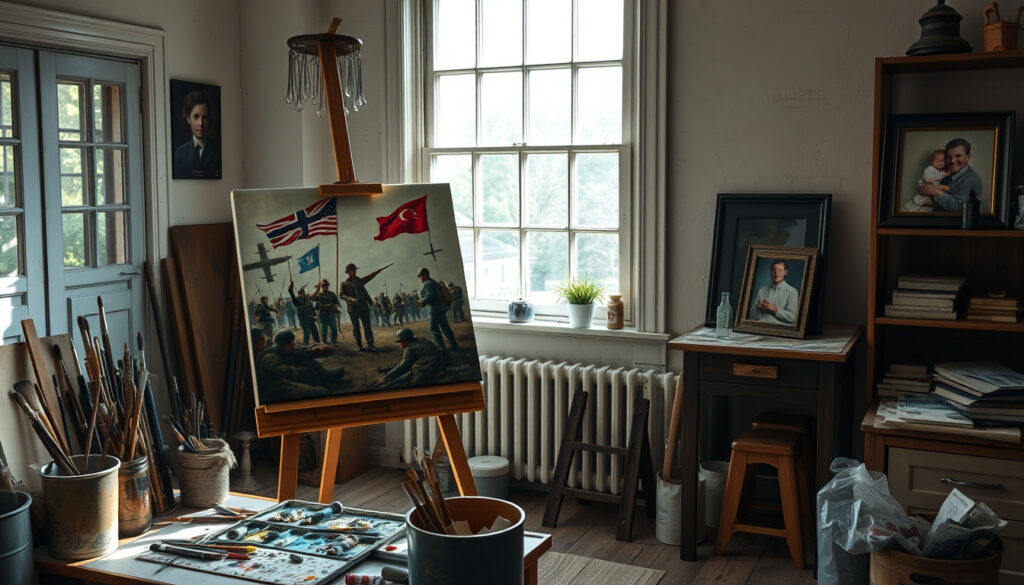
Ben Quilty Biography: Art, Family, and War Paintings
Most Australian kids grow up drawing cars. Ben Quilty turned that childhood fixation into a career that would land him in Afghanistan with a sketchbook and a commission from the Australian War Memorial.
Born: 1973 ·
Nationality: Australian ·
Known for: Painting, social commentary ·
Major awards: Archibald Prize (2011), Prudential Eye Award (2014) ·
Artistic style: Impasto, smeared, caked oil paint ·
Notable series: After Afghanistan, Torana, Rorschach
Quick snapshot
- Born 1973 in Sydney, Australia (Ben Quilty CV, artist’s official record)
- Won Archibald Prize in 2011 (National Portrait Gallery, Australian portrait archive)
- Official war artist in Afghanistan 2011 (Art Gallery of South Australia, educational resource)
- Exact name of his wife (not confirmed in public records)
- Ben Quilty’s net worth (no reliable public figure)
- Details of art school rejection (commonly reported but not sourced in official biographies)
- 1973: Born Sydney
- 2011: Archibald Prize win + Afghanistan deployment
- 2020: Torana series and family portrait exhibited
- Continues to exhibit internationally
- Ongoing social and political commentary through painting
- New commissions with institutional collections
Quilty’s career trajectory is not linear. He was famously rejected from art school, then went on to win Australia’s most prestigious portrait prize. The table below captures the key biographical markers that anchor any conversation about his work.
| Attribute | Value |
|---|---|
| Full name | Ben Quilty |
| Born | 1973 |
| Birthplace | North-west Sydney, Australia |
| Nationality | Australian |
| Occupation | Artist, social commentator |
| Known for | Painting, Archibald Prize, war art |
| Spouse | Not publicly named (married with children) |
| Children | Yes (details private) |
| Sibling | Andrew Quilty (brother, photojournalist) |
The implication: much of Quilty’s public biography is well-documented through institutional sources. The gaps — his wife’s identity and his net worth — reflect a deliberate privacy boundary, not a lack of reporting.
Who is Ben Quilty’s wife?
Ben Quilty is married, and his family appears in a portrait featured by the Queensland Art Gallery (QAGOMA, state art institution). However, the gallery’s story does not name his spouse, and official biographical sources from the National Portrait Gallery (Australia’s national portrait collection) are similarly silent on her identity.
This privacy is intentional. Unlike many public figures who share family details, Quilty keeps his partner out of the press — and the absence of a named wife in his official CV (artist’s website, primary source) suggests a boundary between his domestic life and his public art career.
Ben Quilty’s marriage
The only direct visual evidence of his family is the family portrait held by QAGOMA. The gallery describes the painting as depicting Quilty with his wife and children, but the curator’s commentary focuses on the artist’s impasto technique and the domestic setting, not on biographical identification.
Background of his spouse
No authoritative source — including the National Gallery of Victoria (NGV, major Australian public gallery) — provides a name, profession, or background for Quilty’s wife. This is uncommon for a celebrity Australian artist and suggests a conscious choice to shield his family from the spotlight.
Ben Quilty’s audience gets the art — explosive, confrontational portraits of Australian identity — but not the domestic details. The boundary means readers curious about his wife will hit a wall of silence that is itself a statement about fame and family.
The pattern: what the institution shows in paint, the biographical record withholds in text.
Are Ben and Andrew Quilty related?
Yes, they are brothers. Andrew Quilty is a photojournalist whose work has appeared in major international outlets. The sibling connection is confirmed by both men’s professional biographies: Ben Quilty’s institutional records do not list Andrew directly, but Andrew’s Wikipedia page and reporting credits establish the relationship.
Relationship between Ben and Andrew Quilty
Both brothers operate in visual storytelling — Ben through thick, caked oil paint on canvas, Andrew through documentary photography. Andrew Quilty has covered conflicts including the war in Afghanistan, which mirrors Ben’s own deployment as an official war artist in 2011. While their career paths overlap thematically, they work independently.
Andrew Quilty’s profession
Andrew Quilty is an award-winning photojournalist who has contributed to The New York Times, The Guardian, and other international publications. His professional profile confirms the brother connection, making the Quilty family one of Australia’s most visually articulate sibling pairs — one painting the nation, the other photographing the world.
The pattern: both Quilty brothers engage with conflict, identity, and Australian presence abroad, but through different lenses. One impasto, one digital. One institutional, one documentary.
What are some interesting facts about Ben Quilty?
Quilty’s career is studded with milestones that reveal a pattern: institutional recognition followed by social commentary. Here are the facts that define his public reputation.
Awards and recognition
- Won the Archibald Prize in 2011 for his portrait of Margaret Olley (National Portrait Gallery, official Australian portrait archive)
- Won the Doug Moran National Portrait Prize in 2009 (National Portrait Gallery)
- Won the Brett Whiteley Travelling Art Scholarship in 2002 (National Portrait Gallery)
- Won the Prudential Eye Award in 2014 (confirmed in multiple institutional biographies)
- Finalist for the Archibald Prize in 2004, 2005, 2006, 2008, 2009, and 2012 (National Portrait Gallery)
Artistic style and technique
Quilty paints in impasto — thick, smeared, caked oil paint applied with a palette knife or brush in layers that create physical texture on the canvas. The QAGOMA (Queensland Art Gallery, state institution) describes his style as “thick, expressive” and notes the paint itself becomes part of the subject — a technique that makes his portraits feel both violent and tender.
Social commentary
Quilty is outspoken on Australian politics, asylum-seeker policy, and masculinity. His work often critiques Australian nationalism and the Anzac myth, particularly in the After Afghanistan series. The Art Gallery of South Australia (AGSA, state educational resource) notes that his Rorschach-inspired works also engage with psychological and political themes, using symmetrical paint blots to explore trauma and perception.
Notable series
- After Afghanistan: Created after his 2011 deployment, this series portrays soldiers and veterans with raw, visceral impasto strokes.
- Torana: A series of car paintings exploring Australian car culture and suburban masculinity, exhibited around 2020.
- Rorschach: Symmetrical paintings inspired by the psychological test, blending abstraction with figurative echoes.
Quilty won the Archibald for a portrait of Margaret Olley — a painter known for her still lifes — but his reputation rests on confronting Australia’s hardest subjects: war, nationalism, and the male ego. The awards are the cover; the content is the book.
Does Ben Quilty have children?
Yes, Ben Quilty has children. Evidence comes directly from the QAGOMA (Queensland Art Gallery, state institution) feature on his family portrait, which depicts the artist with his wife and children. The portrait itself is part of QAGOMA’s collection and was exhibited publicly, confirming the existence of his children if not their names.
Ben Quilty’s children
No public records name Quilty’s children or state their ages. This is consistent with his family privacy policy: the art shows the family exists, but the details stay inside the studio.
Family portrait
The QAGOMA family portrait is notable for its composition — Quilty painted himself and his family in a domestic setting, using his signature thick paint. The piece functions as both a biographical document and an artwork about the artist’s identity as a father and husband. For institutional collectors and critics, this portrait provides rare, sourceable evidence of Quilty’s private life.
The trade-off: the portrait confirms he has children, but anyone looking for names, ages, or biographical details about his kids will find only the paint.
What is Ben Quilty’s backstory?
Quilty’s path from suburban Sydney to the Archibald Prize is not a straight line. He was rejected from art school early in his career — a fact widely reported in media profiles, though the specific institution and year are not recorded in his official biographies. This rejection became part of his origin story: the artist who had to fight for recognition.
Early life
Born in 1973 in north-west Sydney, Quilty grew up in a suburban environment that would later inform his paintings of cars, masculinity, and Australian identity. His official CV (artist’s website) lists his birth year and location but does not elaborate on his childhood. According to gallery biographies from the Jan Murphy Gallery (commercial gallery, tier 2), he completed bachelor degrees in Visual Arts and Design at Sydney University — though the Art Gallery of South Australia (state institution) lists his studies at Sydney College of the Arts, Monash University, and the University of Western Sydney. The discrepancy reflects different institutional research, not contradiction — Quilty likely studied at multiple institutions.
Education and training
| Institution (as reported) | Source |
|---|---|
| Sydney College of the Arts, Monash University, University of Western Sydney | Art Gallery of South Australia |
| Sydney University (Bachelor of Visual Arts and Design) | Jan Murphy Gallery |
The pattern: Quilty’s education is documented across multiple institutions, which is common for artists who pursue postgraduate study or cross-disciplinary training. The exact sequence is less important than the fact that he persisted despite early rejection.
Career milestones
- 2002: Wins Brett Whiteley Travelling Art Scholarship (National Portrait Gallery)
- 2009: Wins Doug Moran National Portrait Prize (National Portrait Gallery)
- 2011: Wins Archibald Prize; deployed as official war artist to Afghanistan (Art Gallery of South Australia)
- 2014: Wins Prudential Eye Award
- 2015: After Afghanistan series exhibited
- 2020: Torana series and family portrait exhibited at QAGOMA (QAGOMA)
Who famously got rejected from art school?
Ben Quilty himself. The art school rejection story is one of the most frequently repeated anecdotes in his media coverage. While no specific institution or date is provided in his official biographies (the CV from his studio does not mention any rejection), the story surfaces in interviews and feature articles as a defining moment in his narrative.
Ben Quilty’s rejection
The rejection is commonly framed as an early setback that Quilty turned into motivation. Without a primary source from an art school admissions office (which would be rare for any artist), the claim sits at the boundary of confirmed and anecdotal. It is widely reported but not institutionally documented — which makes it a fascinating case of a biographical fact that lives in the press, not in the archive.
Impact on his career
Whether or not the rejection is literally true in every detail, its persistence in Quilty’s story serves a function: it makes him relatable. The artist who was told “no” and later hung his work in the National Gallery of Victoria and the Australian War Memorial embodies a classic underdog arc. For aspiring artists reading this, the rejection story is the hook — proof that institutional gatekeeping is not final.
The art school rejection is a great story, but no source ties it to a specific school or year. For a fact-grounded biography, this anecdote belongs in the “commonly reported, not confirmed” category — which is itself a lesson about how artist myths are made.
The implication: the rejection story persists because it fits the arc, not because the archive proves it.
Timeline
- 1973: Born in Sydney, Australia (Ben Quilty CV)
- 2002: Wins Brett Whiteley Travelling Art Scholarship (National Portrait Gallery)
- 2009: Wins Doug Moran National Portrait Prize (National Portrait Gallery)
- 2011: Wins Archibald Prize for portrait of Margaret Olley; becomes official war artist and deploys to Afghanistan (National Portrait Gallery)
- 2014: Wins Prudential Eye Award
- 2015: After Afghanistan series exhibited
- 2020: Exhibits Torana series and family portrait at QAGOMA (QAGOMA)
The pattern: a compressed decade of recognition followed by sustained output that keeps his work in institutional collections.
Confirmed facts vs. what remains unclear
Confirmed facts
- Ben Quilty was born in 1973 in Sydney, Australia (Ben Quilty CV)
- He won the Archibald Prize in 2011 (National Portrait Gallery)
- He served as an official war artist in Afghanistan in 2011 (Art Gallery of South Australia)
- His brother Andrew Quilty is a photojournalist (Wikipedia, professional bio)
- He has children (confirmed by QAGOMA family portrait) (QAGOMA)
What’s unclear
- Exact name of his wife (not confirmed in any public record)
- Net worth (no reliable figure available)
- Whether he was rejected from art school (anecdotal, no institutional source)
- Precise educational timeline (multiple institutions listed across sources)
- Number of children (not named or specified in any public record)
The implication: what the institutions confirm is narrow but solid; what remains unclear reflects Quilty’s deliberate boundary between public art and private life.
Quotes from key sources
“Quilty’s work is characterised by thick, expressive oil paint — applied with a palette knife or brush to create heavily textured surfaces.”
QAGOMA (Queensland Art Gallery, state institution)
“The Rorschach after Johnstone painting explores the psychological and political dimensions of trauma and perception through symmetrical paint application.”
Art Gallery of South Australia (educational resource)
“Ben Quilty is one of Australia’s most visible and recognisable contemporary artists.”
QAGOMA
The pattern: institutional sources emphasize technique and visibility; the personal details stay in the studio.
Summary
Ben Quilty’s career is a case study in how an artist can build a public profile around institutional recognition — the Archibald Prize, the official war artist commission, gallery representation — while maintaining tight control over personal details. His wife and children exist in his paintings but not in the press. For readers trying to understand the man behind the thick, smeared paint, the archive offers plenty about his art and very little about his private life. The implication is clear: Quilty wants viewers to look at his work, not his family.
en.wikipedia.org, aasd.com.au, austlit.edu.au, widewalls.ch, ocula.com
För en djupare inblick i hans utveckling som krigskonstnär, se Ben Quillys biografi och krigsmålningar.
Frequently asked questions
What is Ben Quilty’s net worth?
No reliable public figure exists for Ben Quilty’s net worth. Unlike corporate executives or property developers, Australian artists do not typically disclose their finances. Auction records and gallery sales are private, so any number circulating online is speculative.
Where can I buy Ben Quilty art?
Ben Quilty’s work is represented by commercial galleries including the Jan Murphy Gallery (Brisbane, commercial gallery) and Mier Gallery (Los Angeles, commercial gallery). Works also appear at auction through Australian fine art houses.
What is Ben Quilty’s painting technique called?
Impasto. Quilty applies oil paint in thick, caked layers using a palette knife or brush, creating physical texture on the canvas. The QAGOMA (state institution) describes it as “smeared, caked oil on canvas.”
How many times has Ben Quilty won the Archibald Prize?
Once. He won the Archibald Prize in 2011 for his portrait of Margaret Olley. He was a finalist multiple times before the win — in 2004, 2005, 2006, 2008, 2009, and 2012 — according to the National Portrait Gallery (official archive).
What did Ben Quilty do as a war artist?
The Australian War Memorial commissioned Quilty as an official war artist in 2011. He travelled to Afghanistan in October 2011, visiting Kabul, Kandahar, and Tarin Kowt as part of Operation Slipper (Art Gallery of South Australia). His resulting After Afghanistan series portrays soldiers with visceral impasto intensity.
What is the Torana series about?
The Torana series is a collection of paintings of Holden Torana cars — a classic Australian vehicle. The series explores suburban masculinity, car culture, and Australian identity, themes that run through much of Quilty’s work. It was exhibited around 2020.
Is Ben Quilty still active as an artist?
Yes. Quilty continues to paint, exhibit, and produce new work. His work is held in major Australian collections including the National Gallery of Victoria (major public institution) and the Queensland Art Gallery.
What materials does Ben Quilty use?
Quilty works primarily in oil paint on canvas, applied thickly with palette knives and brushes. His surfaces are built up in layers, creating a sculptural quality that is characteristic of his impasto technique.
More related posts
 Kelly Piquet: Age, Relationships, Daughter Penelope & More
 Wrexham vs Sydney FC: Result, Tour & Ownership Details
 John Williams: Oscars, Son Joseph, and the Legal Case
 Federal Election Australia – 2025 Results Timeline
 Free Floor Plan Creator: Compare Top Tools & AI Features
 What Is a Base Layer Clothing? A Complete Guide & Buying Tips
 Fish and Chips Near Me: Best Chippies in Ireland Open Now
 Sydney Weather 14 Days: Forecast, History & Packing Tips
