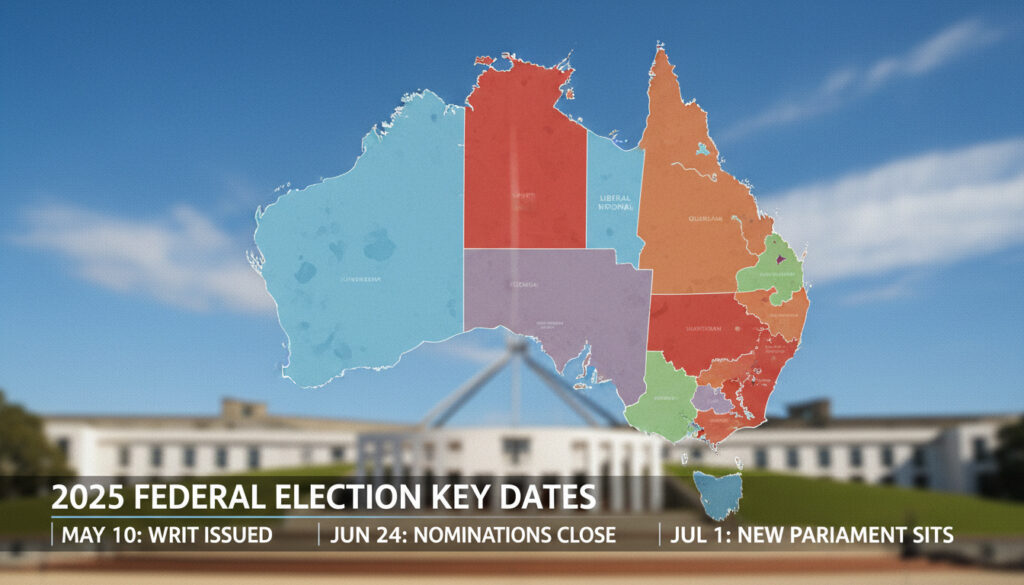
Federal Election Australia – 2025 Results Timeline
The 2025 Australian federal election concluded on Saturday, 3 May 2025, delivering a decisive second term to Prime Minister Anthony Albanese and the Australian Labor Party. The poll, described by the Australian Electoral Commissioner as the nation’s largest ever federal election, saw the Labor government secure a landslide victory over Peter Dutton’s Liberal–National Coalition across 150 House of Representatives seats and 40 Senate positions.
Electoral enrollment reached record levels, with compulsory participation required for all citizens aged 18 and over. The electoral process unfolded across a tightly scheduled seven-week timeline from the issuing of writs to the seating of new senators, while strategic timing ensured the federal contest avoided collision with Western Australia’s state election held two months prior.
When Was the 2025 Election Held and When Is the Next One?
The 2025 poll followed constitutional requirements mandating a federal election at least every three years. While speculation suggested a possible April date, Prime Minister Albanese announced the 3 May election on 28 March 2025, following the federal budget. Official records confirm the government was returned with an expanded majority.
- Labor achieved a landslide victory securing a second consecutive term
- All 150 House of Representatives seats were contested
- 40 of 76 Senate seats were decided in a half-Senate election
- The Australian Electoral Commissioner designated it Australia’s largest ever federal election
- Voting remained compulsory for all citizens over 18 years of age
- The next federal election must occur by 27 September 2028
| Fact | Details |
|---|---|
| Polling Day | Saturday 3 May 2025 (8 am – 6 pm) |
| House Seats Contested | 150 |
| Senate Seats Contested | 40 of 76 |
| Issue of Writs | Monday 31 March 2025 |
| Enrollment Deadline | 8 pm, Monday 7 April 2025 |
| Nominations Closed | Noon, Thursday 10 April 2025 |
| Early Voting Opened | Tuesday 22 April 2025 |
| Return of Writs | Thursday 12 June 2025 |
| Senators Take Seats | 1 July 2025 |
| Parliamentary Term Expires | 21 July 2028 |
| Latest Next Election | 27 September 2028 |
| Voting System | Compulsory preferential |
Election Outcome and Parliamentary Results
Official results confirmed Anthony Albanese’s Labor government defeated the Liberal–National Coalition led by Peter Dutton. The outcome represented a significant consolidation of power for the incumbent administration, with voters endorsing the government’s policy agenda despite economic headwinds.
House of Representatives
The contest for the 150 lower house seats determined government formation. Labor’s victory ensured a working majority in the chamber, allowing Albanese to continue legislative programs without crossbench reliance. The result maintained the government’s control of the treasury benches while reducing the opposition’s parliamentary representation.
Senate Composition
The half-Senate election determined 40 of the 76 upper house positions. Senators elected on 3 May 2025 assumed their seats on 1 July 2025, reshaping the legislative chamber’s balance of power. The new Senate configuration will influence the government’s capacity to pass contentious legislation during the 47th Parliament.
According to the Australian Electoral Commissioner, the 2025 election represented Australia’s largest ever federal electoral event by participation numbers, surpassing previous benchmarks for voter enrollment and ballot processing.
Key Seats and Major Parties
The 2025 contest primarily featured two major political blocs vying for control of the legislature, with several marginal constituencies determining the ultimate margin of victory.
Australian Labor Party
Seeking re-election after winning government in 2022, Labor campaigned on its record of economic management and social policy reform. The party’s ability to retain outer-suburban and regional seats proved crucial to securing majority government, while defending previously marginal electorates against opposition challenges.
Liberal–National Coalition
The opposition entered the election requiring significant seat gains to form government. Led by Peter Dutton, the Coalition focused on cost-of-living pressures and energy policy, attempting to reclaim seats lost in the 2022 election. The landslide result suggested these messages failed to resonate sufficiently with swing voters.
Decisive Electoral Battlegrounds
While specific seat-by-seat results varied, the election’s outcome hinged on voter sentiment in metropolitan fringes and regional centers. July 2025 Calendar – Free Printable PDF with Holidays marks the month when newly elected senators began their legislative duties, following the July 1 seating date.
How Voting Worked and Enrollment Requirements
Australia’s electoral system combines compulsory participation with preferential voting, requiring citizens to rank candidates rather than selecting a single preference.
Preferential Voting System
Voters in both houses allocated preferences numerically, with the distribution of preferences determining winners in contests where no candidate achieved an absolute majority of primary votes. This system ensures elected representatives ultimately secure majority support after the distribution of lower-preference ballots.
Enrollment and Overseas Participation
Compulsory enrollment applied to all Australian citizens aged 18 years and older, with the electoral roll closing at 8 pm local time on 7 April 2025. Diplomatic missions including Chennai and Vientiane facilitated overseas voting through in-person centers and postal ballot arrangements.
Australian citizens abroad could cast ballots at designated overseas voting centres or apply for postal votes. Missions worldwide established temporary polling places to accommodate expatriate participation, with voter services operating through diplomatic posts across multiple time zones.
Strategic Timing Considerations
The 3 May date was selected specifically to avoid conflict with the Western Australian state election held on 8 March 2025. This scheduling prevented administrative overlap and voter confusion between the two contests, allowing the Australian Electoral Commission to allocate resources efficiently across jurisdictions.
Failure to enroll by the 7 April 2025 deadline rendered citizens ineligible to participate in the 3 May election. The compulsory enrollment requirement applied nationwide, with penalties for non-compliance under the Commonwealth Electoral Act.
Timeline of the 2025 Federal Election
- : Issue of writs formally commencing the election period (source)
- : Close of electoral rolls at 8 pm local time (source)
- : Close of candidate nominations at noon
- : Early voting commences for eligible voters
- : Polling day (8 am until 6 pm)
- : Return of the writs to the Governor-General
- : Senators elected in the 2025 poll take their seats
Established Facts and Remaining Uncertainties
Confirmed Information
- Election held 3 May 2025 with Labor victory
- 150 House seats and 40 Senate seats contested
- Voter enrollment compulsory for citizens 18+
- Writs returned 12 June 2025
- Senators seated 1 July 2025
- Next election must occur by 27 September 2028 (source)
Outstanding Questions
- Exact date of the 2028 federal election (determined by future Prime Minister)
- Final certified margins in specific House divisions
- Long-term leadership stability within opposition parties
- Precise voter turnout percentages pending final AEC tabulation
Historical and Strategic Context
The 2025 election occurred amid prolonged economic uncertainty and housing affordability concerns that dominated public discourse throughout the parliamentary term. Labor’s ability to secure a second term despite these pressures reflected voter confidence in the government’s management of international trade relationships and industrial relations frameworks.
Understanding workplace entitlements remained relevant throughout the campaign, particularly regarding public sector wages and conditions. Workers seeking clarification on compensation structures during the electoral period might reference What Is Leave Loading – Eligibility, Calculation & Payout Guide for detailed information on statutory employment benefits.
The election’s timing demonstrated strategic calibration by the Prime Minister, who delayed the poll until May to avoid Western Australia’s March state election while capitalizing on budget announcements. This approach minimized voter fatigue and maximized administrative resources available to the Australian Electoral Commission.
Official Statements and Electoral Authority
“Australia’s largest ever federal election.”
— Australian Electoral Commissioner, describing the 2025 electoral event (AEC Media Release)
“The current Parliament’s three-year term expires on 21 July 2028.”
— Parliamentary Library, regarding the constitutional deadline for the next election (Parliamentary Library)
Summary
The 2025 Australian federal election delivered a landslide victory to Anthony Albanese’s Labor government on 3 May 2025, confirming the party’s mandate for a second consecutive term. With 150 House seats and 40 Senate positions decided, the electoral outcome reshaped the parliamentary landscape, while the next nationwide poll must occur before 27 September 2028. As the 47th Parliament commenced on 1 July 2025, the legislative agenda shifted toward implementing the government’s renewed mandate.
Frequently Asked Questions
What constitutes a landslide victory in Australian federal elections?
A landslide typically describes a result where the winning party secures a substantial parliamentary majority beyond the minimum 76 seats needed for government, often including the defeat of high-profile opposition figures and the capture of previously safe opposition seats.
How can I enroll for the next federal election in 2028?
Australian citizens aged 18 and over must enroll through the Australian Electoral Commission website or offices. Enrollment is compulsory, and the roll will close approximately one week after the writs are issued for the 2028 election, expected by September 2028.
What is a half-Senate election?
A half-Senate election occurs when only half of the 76 Senate seats (40 positions) are contested, as happened in 2025. Senators serve six-year terms, with half facing election every three years alongside House elections or separately.
What happens if no party wins a majority in the House?
In the event of a hung parliament, the incumbent Prime Minister seeks to form alliances with crossbench independents or minor parties to secure confidence and supply. If unsuccessful, the Governor-General may invite the opposition leader to attempt government formation.
How do overseas voting procedures work?
Australian citizens abroad can vote in-person at designated overseas centers established at embassies and consulates, or apply for postal ballots. These services operate during designated early voting periods and on polling day according to local time zones.
What is the significance of 1 July 2025?
Senators elected on 3 May 2025 assumed their parliamentary seats on 1 July 2025, marking the formal commencement of the new Senate’s six-year terms and the reconvening of the 47th Parliament with updated representation.
More related posts
 Josh Weddle: Contract, Injury, Family, and Career Facts
 Linda Reynolds: Career, Controversy, and Retirement
 Newmarket Family Doctors – Clinics Accepting New Patients
 Peter Andre: Biography, Wife, Children, Net Worth & Custody
 July 2025 Calendar – Free Printable PDF with Holidays
 Brenden Abbott: Where Is the Postcard Bandit Now
 Ben Quilty Biography: Art, Family, and War Paintings
 Alan Dershowitz: Harvard Law, Trump, Epstein Controversies
