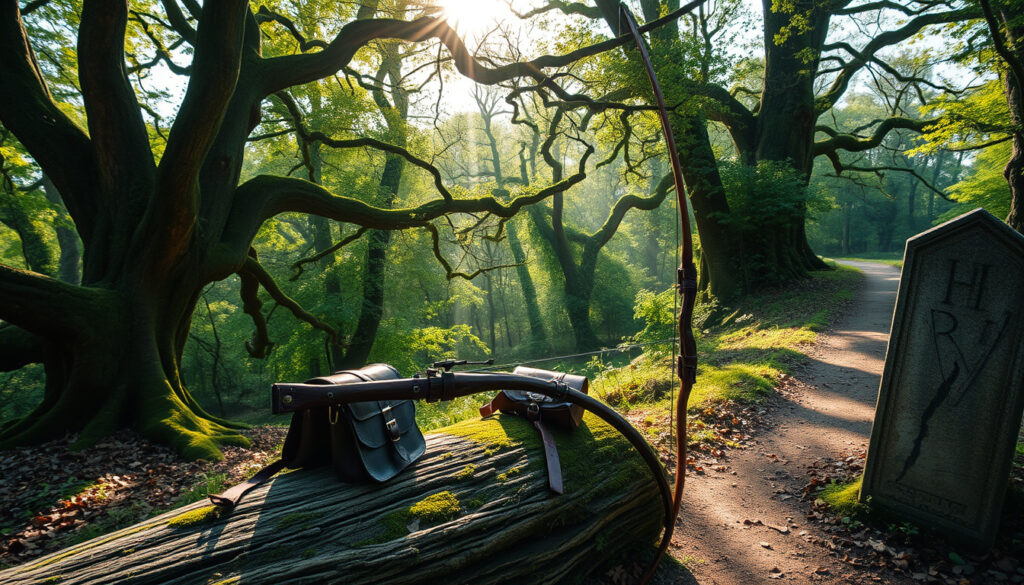
Robin Hood: Historical Fact vs. Legend | Real Story & Origins
The name Robin Hood conjures up a familiar image: a dashing outlaw in Lincoln green, robbing the rich to feed the poor under the boughs of Sherwood Forest. But the character we know from Hollywood and children’s books is a surprisingly recent invention, and the historical roots of the legend are far more tangled—and more northern—than most people realize. In this article, we’ll trace the real story behind the myth, separate the centuries of embellishment from the few known facts, and explore why each generation has felt the need to remake Robin Hood in its own image.
Earliest known mention: c. 1377 (Piers Plowman) ·
Centuries of oral tradition before first written ballad: at least 200 years ·
Number of surviving medieval Robin Hood ballads: 38 ·
Location of Sherwood Forest today: Nottinghamshire, 1,000+ acres remnant ·
Consensus among historians on historical existence: none verified
Quick snapshot
- The legend of Robin Hood appears in English folklore from at least the late 14th century (Encyclopaedia Britannica).
- Sherwood Forest is a real, extant nature reserve in Nottinghamshire (Nottinghamshire County Council).
- Earliest ballads place Robin Hood in Yorkshire, not Nottinghamshire (Encyclopaedia Britannica).
- Whether there was a single real person named Robin Hood who inspired the legend.
- The identity of any historical models (Robert Hod of York, Robert of Loxley, etc.).
- The exact cause and location of the historical figure’s death.
- c. 1377: First literary mention in Piers Plowman (Historic UK).
- c. 1450: Earliest surviving full ballad, ‘Robin Hood and the Monk’. (Historic UK)
- 1500s: Addition of Maid Marian and Friar Tuck (Encyclopaedia Britannica).
- Ongoing historical research continues to uncover medieval records that may or may not link to the legend.
- Tourism in both Yorkshire and Nottinghamshire will keep the debate alive for commercial reasons.
The pattern across the data is clear: the earliest evidence points north, while the popular imagination has firmly settled in Nottinghamshire.
| Attribute | Value |
|---|---|
| Earliest reference | c. 1377, Piers Plowman (Historic UK) |
| First surviving ballad | c. 1450, Robin Hood and the Monk |
| Number of surviving medieval ballads | 38 (Child ballads) |
| Location in earliest ballads | Barnsdale, Yorkshire (Yorkshire Post) |
| Place of death in legend | Kirklees Priory, West Yorkshire |
| Modern Sherwood Forest | National Nature Reserve, Nottinghamshire (Nottinghamshire County Council) |
The implication: the geographical tug-of-war is not just a historical dispute—it reflects how each region uses the legend to shape its own identity.
Was Robin Hood a real person in history?
The question that stumps historians and fuels pub debates: is there a kernel of truth behind the greenwood tales? The honest answer is that we simply don’t know—and the evidence is too thin to be sure either way.
What historians agree on
- The earliest surviving literary reference to Robin Hood appears in William Langland’s Piers Plowman (c. 1377), where a character mentions “rhymes of Robin Hood” as a well-known story (Historic UK).
- No contemporary chronicle or legal record from before the 13th century names a historical outlaw matching the legend in any detail.
- Multiple medieval outlaws with similar names appear in local records, but none can be conclusively linked to the ballads (National Geographic).
Why the evidence is inconclusive
- The name “Robin Hood” appears to have been a generic term for an outlaw in the Middle Ages, similar to “John Doe” today (Encyclopaedia Britannica).
- The ballads attribute superhuman archery and improbable escapes to Robin, characteristics more typical of folklore than biography.
- A 1226 pipe roll mentions a fugitive named Robert Hod in Yorkshire, but the connection is speculative (National Geographic).
The paradox for historians: The historical record is too sparse to confirm a single real Robin Hood, but the name was clearly a familiar outlaw archetype by the late 14th century. For curious readers, the best bet is to treat the legend as a composite of several real outlaws and a lot of storytelling. For historians, the evidence remains frustratingly thin.
The very absence of a definitive historical Robin Hood may be the reason the legend has survived so long: a blank slate onto which each century can project its own anxieties.
What’s the real story of Robin Hood?
The “real story” depends on which century you ask. The medieval ballads describe a very different character from the Victorian gentleman thief or the Hollywood swashbuckler.
The medieval ballads
- The core medieval plot: a yeoman outlaw in the greenwood who robs from the rich (churchmen, officials) and aids the poor (Visit Sherwood Forest).
- Robin Hood is consistently set in Barnsdale (Yorkshire) in early ballads, not Sherwood Forest (Nottinghamshire) (Yorkshire Post).
- The ‘merry men’ and Maid Marian appear only in later 16th-century additions (Encyclopaedia Britannica).
The evolution into a noble thief
- By the 16th century, playwrights like Anthony Munday began to portray Robin as a dispossessed nobleman, Robin of Loxley (Historic UK).
- Howard Pyle’s 1883 The Merry Adventures of Robin Hood cemented the modern children’s version, banishing the violence of the original ballads.
- The famous phrase “robbing the rich to give to the poor” is a 19th-century paraphrase, not found in medieval sources.
The pattern: each generation has softened Robin’s rough edges to fit contemporary sensibilities, turning a violent outlaw into a lovable folk hero.
Did Robin Hood exist? Evidence for and against
Let’s weigh the arguments on both sides.
Arguments for a historical Robin Hood
- Pro: a 1262 court roll entry references “Robin Hood” as a fugitive in Yorkshire (National Geographic).
- Pro: a 1226 pipe roll mentions a fugitive named Robert Hod in Yorkshire (National Geographic).
- Some traditions place Robin Hood as a Wakefield man linked to Thomas of Lancaster’s rebellion in 1322 (Historic UK).
Arguments against a single historical figure
- Against: the name was a generic term for an outlaw in the Middle Ages, similar to “John Doe” (Encyclopaedia Britannica).
- Against: the Robin Hood of ballads possesses superhuman archery and improbable escapes, typical of folklore.
- Against: the earliest literary references treat him as a known fictional character, not a historical person.
The consequence for historians: The evidence for a historical Robin Hood is circumstantial at best. For those who want to believe, there are tantalizing fragments; for skeptics, the legend is a product of collective storytelling. The smartest position is to remain agnostic.
Is Robin Hood from Nottingham or Yorkshire?
This is the great geographical dispute of the legend. The earliest sources say Yorkshire; popular culture says Nottinghamshire. Here’s how the shift happened.
The Yorkshire claim in the earliest ballads
- The earliest surviving ballad, “Robin Hood and the Monk” (c. 1450), places the story in Barnsdale, Yorkshire (Discover Britain).
- Early tales are set in Barnsdale Forest, north of Doncaster in present-day West Yorkshire (Yorkshire Post).
- The dialect of the early ballads is described by some sources as Yorkshire-based (Discover Britain).
How Nottinghamshire’s Sherwood Forest became the standard setting
- Sherwood Forest appears first in “Robin Hood and the Curtal Friar” (c. 1500) (Visit Sherwood Forest).
- The 16th-century literary tradition by Anthony Munday and others shifted the setting south (Encyclopaedia Britannica).
- Nottinghamshire tourism materials now link several sites to Robin Hood, including the Major Oak and Edwinstowe (Nottinghamshire County Council).
Yorkshire has the older textual evidence, but Nottinghamshire has the brand recognition—and the tourist infrastructure. The winner? Sherwood Forest, thanks to a 16th-century rebranding that stuck.
What was the cause of Robin Hood’s death?
Even in death, the legend is ambiguous. The medieval ballad “Robin Hood’s Death” (Child ballad 120) offers a grim and specific story.
The version told in “Robin Hood’s Death”
- In the medieval ballad, Robin Hood is betrayed by the Prioress of Kirklees, who bleeds him to death while he is ill (Historic UK).
- The death occurs at Kirklees Priory in West Yorkshire.
- Later versions add Little John’s vengeance and a more heroic death scene.
The pattern: even the death story has been rewritten to make Robin more sympathetic—a victim of betrayal rather than a simple outlaw killed in a fight.
What was Robin Hood’s famous line?
The line everyone knows—”robbing from the rich to give to the poor”—isn’t actually medieval. Let’s trace the real quotes.
Quotes from the medieval ballads
- In early ballads, Robin says he will not harm a poor man or a laborer; his targets are clergy, sheriffs, and king’s officials.
- Of the famous line, Encyclopaedia Britannica reports that “rob from the rich” is a 19th-century paraphrase, not medieval.
Famous lines from film and pop culture
- The 1938 Errol Flynn film popularized “Welcome to Sherwood, my lady!”
- Disney’s 1973 animated version gave us “Robin Hood and Little John walkin’ through the forest.”
- Russell Crowe’s 2010 film added a more serious, political tone.
The catch: the most famous “Robin Hood line” is a Victorian invention, proving that the legend is always a product of its time.
Does Sherwood Forest in England still exist?
Yes—and it’s one of the most visited natural sites in the East Midlands.
The current state of Sherwood Forest
- Sherwood Forest is a 1,000+ acre nature reserve in Nottinghamshire, managed by the Sherwood Forest Trust (Visit Sherwood Forest).
- The Major Oak, an 800-1000 year old oak, is a landmark in the forest traditionally linked to Robin Hood.
- Sherwood Forest National Nature Reserve is open to the public year-round.
The implication: even if the historical Robin Hood never set foot in Sherwood, the forest itself has become a shrine to the legend—and worth a visit for anyone curious about the myth.
Timeline: How the Robin Hood legend evolved
- : First literary mention in William Langland’s poem Piers Plowman (Historic UK).
- : Earliest surviving full ballad, Robin Hood and the Monk.
- : Addition of Maid Marian, Friar Tuck, and the Sheriff of Nottingham to the legend (Encyclopaedia Britannica).
- : First publication of Robin Hood’s Garland collection.
- : Joseph Ritson publishes influential Robin Hood: A Collection of All the Ancient Poems, Songs, and Ballads.
- : Howard Pyle’s The Merry Adventures of Robin Hood codifies the modern children’s version.
- : Errol Flynn film The Adventures of Robin Hood cements 20th-century popular image.
- : Latest major film adaptation, Robin Hood (Taron Egerton).
What we know and what we don’t
Confirmed facts
- The legend of Robin Hood appears in English folklore from at least the late 14th century.
- Sherwood Forest is a real, extant nature reserve in Nottinghamshire.
- The earliest ballads place Robin Hood in Yorkshire, not Nottinghamshire.
What’s unclear
- Whether there was a single real person named Robin Hood who inspired the legend.
- The identity of any historical models (Robert Hod of York, Robert of Loxley, etc.).
- The exact cause and location of the historical figure’s death.
What historians say
“The evidence for a historical Robin Hood is so thin that it’s more honest to say we simply don’t know. The name itself was a generic outlaw tag.”
— J.C. Holt, medieval historian, author of Robin Hood (1982)
“Robin Hood began as a symbol of class struggle—a yeoman who stood up to corrupt churchmen and officials. Only later did he become a romanticised nobleman.”
— Stephen Basdeo, historian and author
“The earliest records point to Yorkshire, not Nottingham. The Sherwood connection is a Tudor invention that stuck.”
— Oxford Dictionary of National Biography entry for Robin Hood
For the curious reader, the Robin Hood story is a mirror of English cultural history—each century sees its own desires reflected in the greenwood. The legend is unlikely to ever be “solved,” and that may be its greatest strength.
en.wikipedia.org, cnn.com, connexions.org, youtube.com, anglotopia.net
Frequently asked questions
What was Robin Hood’s real name?
No historical figure with that exact name has been confirmed. The name “Robin Hood” may have been a generic alias for outlaws. Some traditions call him Robin of Loxley, but that is a later addition.
When did the Robin Hood stories first appear?
The earliest known reference is in William Langland’s Piers Plowman (c. 1377). The first surviving full ballad dates to around 1450 (Historic UK).
Who was the Sheriff of Nottingham?
The Sheriff of Nottingham is a recurring antagonist in the tales, but he is not named in the early ballads. Later versions give him various names, but no historical figure fits.
What is the Major Oak?
The Major Oak is an 800-1000 year old oak tree in Sherwood Forest, traditionally said to have been Robin Hood’s hiding place. It is a popular tourist attraction (Visit Sherwood Forest).
Did Robin Hood actually steal from the rich and give to the poor?
The phrase is a 19th-century paraphrase. In the medieval ballads, Robin robs wealthy churchmen and officials, but the explicit “give to the poor” motif is not present (Encyclopaedia Britannica).
Why is Robin Hood associated with Sherwood Forest?
Sherwood Forest became the standard setting in the 16th century, when playwrights and balladeers moved the action from Yorkshire to Nottinghamshire. The association stuck due to later tourism and media.
Are there any historical records of Robin Hood?
There are a few court records from the 13th century that mention a “Robin Hood” as a fugitive, but none confirm a legendary outlaw. The evidence is inconclusive.
What does the name ‘Robin Hood’ mean?
It may simply mean “Robin the hooded one” (a common disguise for outlaws). Some scholars suggest “Robin” was a generic name for a robber, and “Hood” referred to a hooded cloak.
More related posts
 Ron Weasley: Biography, Family, and Key Facts
 Trap Bar Deadlift – Muscles Worked, Benefits Vs Conventional
 Election Australia 2025: Full Results, Seats & Map
 Golden State Warrior v Hornet Match Player Stat
 South Melbourne Medical Hub – Hours, Services and Booking Guide
 The Glass Dome Netflix: Plot, Cast & Ending Explained
 Adam Sandler: Net Worth, SNL Firing, and Comeback
 Minnie Riperton: Life, Vocal Range, Cause of Death & Children
