Election Australia 2025: Full Results, Seats & Map
Anthony Albanese’s Labor Party secured a historic landslide victory in the 2025 Australian federal election, winning 94 House seats—the highest number ever achieved by a single party in Australian electoral history. The result reshaped the parliamentary map with the Coalition suffering its worst defeat in recent memory.
Election Date: 3 May 2025 · House Seats Contested: 150 · Labor Seats: 94 · Coalition Seats: 43 · Results Official: 12 June 2025
Quick snapshot
- Labor won 94 House seats, the most ever by a single party (Wikipedia – 2025 Australian federal election)
- Coalition finished with 43 seats, down from 58 in 2022 (AEC Tally Room – 2025 Federal Election)
- Labor retained every one of its existing seats (Wikipedia – 2025 Australian federal election)
- Detailed vote percentages by electorate remain partially processed
- Full preference flow analysis for Senate cross-votes
- Exact margin shifts in several close battleground seats
- 3 May 2025: Election day held (Wikipedia – 2025 Australian federal election)
- 10 May 2025: AEC Tally Room updated with final results (AEC Tally Room – 2025 Federal Election)
- 12 June 2025: Writs returned, results made official (AEC official site)
- 48th Parliament convenes with Labor majority government
- Senate composition finalized with Labor as largest bloc since 1984
- Next federal election expected around 2028 under fixed three-year terms
The key results table below shows the decisive shift in parliamentary representation, with Labor achieving historic highs while the Coalition suffered significant losses across both chambers.
| Metric | Value |
|---|---|
| Election Date | 3 May 2025 |
| Parliament | 48th |
| House Seats | 150 |
| Labor Seats | 94 |
| Coalition Seats | 43 |
| Results Official | 12 June 2025 |
What were the Australian election results 2025?
The 2025 Australian federal election delivered a result that few had predicted. Anthony Albanese’s Labor Party secured a second term in government, but the margin of victory exceeded what most pre-election polling had suggested. The official count from the Australian Electoral Commission showed Labor winning 94 seats in the House of Representatives—the highest number ever achieved by a single political party in Australian electoral history (Wikipedia – 2025 Australian federal election).
The Coalition, led by Peter Dutton, finished as the opposition with 43 seats, down from 58 at the previous election. This marked a significant swing against the conservative bloc and represented the Coalition’s worst performance in recent memory. The Liberal/National tally from the AEC confirmed the substantial nature of this decline (AEC Tally Room – 2025 Federal Election).
Labor’s two-party-preferred vote stood at 55.22%, the highest recorded since 1975. The party not only held all of its existing seats but actually gained additional seats—a rare feat for any incumbent government. The AEC confirmed that Labor retained every one of its seats, making this the first time a returning government had achieved such complete retention since Harold Holt’s Coalition victory in 1966 (Wikipedia – 2025 Australian federal election).
The pattern of gains across multiple states and from both Liberal and Greens opponents signals a broader realignment in voter preferences that will be studied by political scientists for years to come.
House of Representatives outcomes
All 150 seats in the House of Representatives were contested at this election, down from 151 due to a redistribution that took effect following the 2023 apportionment determination. New South Wales lost one seat (bringing it to 46), Victoria lost one (now at 38), while Western Australia gained one (now at 16). These changes reflected population shifts documented in December 2022 figures.
- Labor: 94 seats (historic high)
- Liberal/National Coalition: 43 seats
- Independents: 10 seats
- Greens: 1 seat
- Centre Alliance: 1 seat
- Katter’s Australian Party: 1 seat
Party seat totals
The seat breakdown revealed a dramatic consolidation of power toward Labor. In New South Wales, Labor won 28 seats—an increase of 2 from the previous election. Victoria saw similar gains with 27 seats, up by 3. Queensland showed the most dramatic shift, with Labor picking up 7 additional seats to reach 12 total. Western Australia contributed 11 seats, an increase of 2 from 2022. These figures come directly from the AEC Tally Room (AEC Tally Room – 2025 Federal Election).
Labor’s gains came from both the Coalition AND the Greens simultaneously—something that rarely happens in Australian politics, where swings typically flow in one direction. This dual expansion signals a broader realignment in voter preferences.
Official declaration date
The Australian Electoral Commission officially certified the results on 12 June 2025, when the writs were returned. The AEC Tally Room had been updated with final House results by 10 June, while the comprehensive Democracy in Action results page was revised on 24 June with the full picture of outcomes across all electorates and the Senate (AEC official election page).
Australian election results seats?
Understanding the seat distribution is essential to grasping what this election means for Australia’s political landscape. With 150 seats available (reduced from 151 due to redistribution), the path to a working majority required 76 seats. Labor crossed that threshold with remarkable ease.
Breakdown by party
The House seat breakdown by party tells a story of contrasting fortunes. Labor’s 94 seats represented the highest number ever won by a single political party in an Australian election—tyling with the Coalition’s 1996 achievement for the record, but marking the first time any party had reached such heights independently. The Greens, by contrast, saw their representation collapse from 4 seats to just 1, with party leader Adam Bandt himself losing the Melbourne electorate to Labor’s Sarah Witty (Democracy in Action – 2025 results).
- Labor: 94 House seats (majority government)
- Liberal Party: seats primarily in eastern states
- National Party: seats primarily in rural Queensland, NSW, Victoria, WA, SA
- The Greens: 1 seat (down from 4)
- Crossbench independents: 10 seats unchanged from previous election
The implication: Labor’s dominance in the lower house signals a fundamental realignment that will require the Coalition and Greens to reassess their electoral strategies significantly.
independents performance
While the major parties dominated headlines, independents held their ground. The crossbench maintained its 10-seat position, with notable individual battles drawing public attention. Three Liberal incumbents fell to challengers: Michael Sukkar lost Deakin to Matt Gregg, and Keith Wolahan lost Menzies to Gabriel Ng, both in seats traditionally considered safe Liberal territory (Democracy in Action – 2025 results).
Total seats contested
The 2025 election contested all 150 House seats and 40 of 76 Senate seats. This made it a half-Senate election, where half the upper house faced renewal alongside the full House of Representatives contest. The redistribution meant that some states had different seat counts than in 2022—NSW and Victoria each lost a seat while WA gained one, affecting how votes translated into seats (Wikipedia – 2025 Australian federal election).
The seat count shift from 151 to 150 wasn’t just administrative—it altered the math for winning a majority. Combined with the swing against the Coalition, this redistribution may have contributed to the final margin in ways still being analyzed by political scientists.
Federal election Australia key details?
Beyond the headline numbers, several structural facts define what made the 2025 election distinctive in Australian political history.
Election date and timeline
The federal election took place on Saturday, 3 May 2025, following the fixed three-year electoral cycle established in Australian constitutional practice. While Australia doesn’t have a constitutionally mandated fixed election date, conventions have established that federal elections typically occur every three years, and the May 2025 date fell within the expected window. The timeline from election day to official certification took approximately six weeks, with the AEC processing millions of votes across 150 electorates and complex Senate preference distributions (Wikipedia – 2025 Australian federal election).
Major parties involved
The two major contenders were the Australian Labor Party, led by Prime Minister Anthony Albanese, and the Liberal/National Coalition, led by Peter Dutton. These two blocs have dominated Australian federal politics for decades. Additional significant parties included The Greens, One Nation, and various micro-parties, plus a substantial field of independent candidates. The two-party system remained firmly intact, with minor parties and independents facing significant structural barriers to winning lower house seats under the preferential voting system (Wikipedia – 2025 Australian federal election).
- Australian Labor Party (Albanese) – incumbent government
- Liberal/National Coalition (Dutton) – opposition
- The Greens (Bandt) – minor party
- One Nation (Hanson) – minor party
- Various independents and micro-parties
Voter turnout facts
Australia maintains mandatory voting for federal elections, which typically produces turnout rates exceeding 90%. While the official turnout figure for 2025 continues to be compiled by the AEC, historical patterns suggest that well over 10 million Australians cast ballots. The combination of optional preferential voting for the House and group ticket voting options for the Senate makes the Australian system somewhat unique among Westminster democracies (AEC official information).
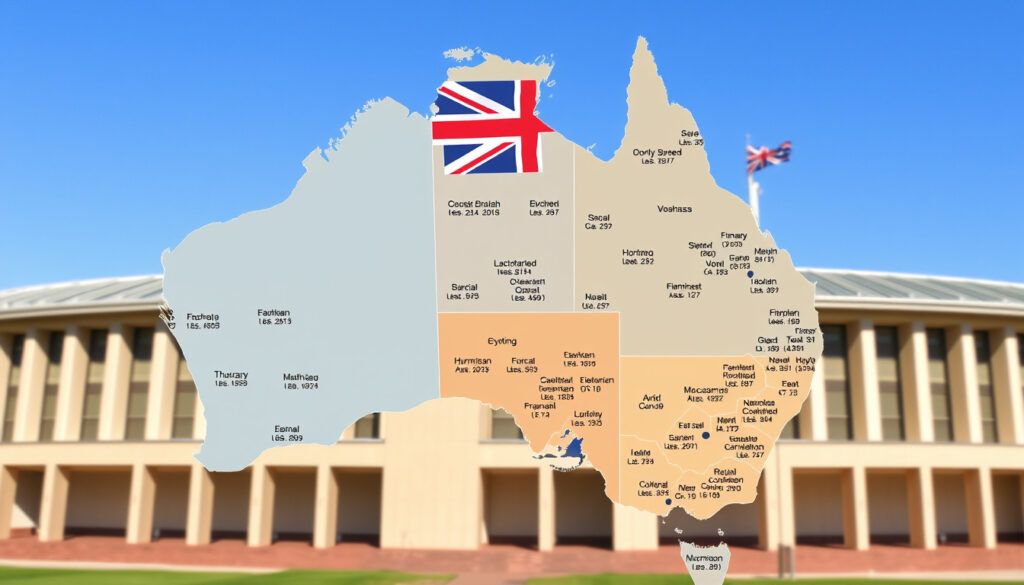
Australian election results map?
For those wanting to explore the results geographically, several official and unofficial resources provide seat-by-seat breakdowns and swing visualizations.
Seat-by-seat visualization
The AEC operates an official election results portal where each electorate’s results are displayed with detailed vote flows, preference distributions, and historical comparisons. This data allows users to see not just who won each seat but how votes flowed through the preferential system. The AEC Tally Room served as the primary official source during the count, with the website updated as results trickled in from each polling place (AEC Tally Room – 2025 results).
The geographic pattern of Labor’s gains—concentrated in Queensland (+7 seats) and Victoria (+3)—suggests different regional dynamics drove the swing. Analysts will be studying whether economic concerns, housing costs, or leadership perceptions drove these variations for months to come.
Swing analysis
The swings against the Coalition were substantial and widespread. In traditional Liberal heartlands like Deakin and Menzies in Melbourne’s eastern suburbs, two-term incumbents fell to first-time candidates. The magnitude of these swings, often exceeding 5-10%, suggested a fundamental shift in voter behavior rather than a localized protest. Meanwhile, areas where the Greens had previously competed—particularly in inner-city Melbourne and Sydney—showed different patterns, with some traditional Liberal-versus-Labor contests becoming three-way races that ultimately favored Labor (Democracy in Action – 2025 results).
Regional highlights
Queensland emerged as the biggest story of the election. Labor’s gain of 7 seats in that state represented the most dramatic state-level swing, with traditionally conservative outer suburban and regional seats moving toward the government. This may reflect frustration with housing costs, energy prices, or other cost-of-living pressures that have particularly affected Queensland residents. Western Australia also showed meaningful movement, with Labor gaining 2 additional seats, while the eastern states of NSW and Victoria each contributed modest but significant increases of 2-3 seats.
When is the next federal election?
With the 2025 election concluded, attention naturally turns to what comes next in the electoral cycle and how the political landscape might shift by the time Australians next head to the polls.
Post-2025 schedule
The next federal election is constitutionally due by mid-2028, following the standard three-year electoral cycle. However, the Prime Minister has discretion over the exact timing within constitutional limits, meaning elections can occur any time between three years from the previous poll and a maximum term as determined by the Constitution. The Albanese government, with its strengthened majority, is under no pressure to seek an early mandate and will likely let the full term run if political conditions remain favorable.
Fixed terms info
Unlike some comparable democracies, Australia does not have constitutionally fixed election dates. The House of Representatives must face election at least every three years, but elections can be called earlier if the government loses a confidence vote or if the Prime Minister advises an early dissolution. The Senate has staggered six-year terms, with half the seats elected every three years—so the 2028 election will again be a double dissolution if it follows historical patterns (Wikipedia – 2025 Australian federal election).
Fixed three-year terms provide predictability for planning but reduce flexibility for governments facing unexpected crises. The Albanese government, given its large majority, may find itself in the unusual position of being able to call an early election from strength—but early elections typically favor opposition more than government.
Prime minister election cycle
The Prime Minister is not directly elected by voters but emerges from within the parliamentary party that controls the House of Representatives. Anthony Albanese has led the government since 2022 and secured his second term in 2025. Assuming Labor retains its majority, Albanese would continue as Prime Minister through the next election cycle. Peter Dutton remains Opposition Leader, but internal Liberal Party dynamics may shift before 2028 as the party reassesses its electoral strategy and leadership profile.
Timeline
From apportionment to official certification, the 2025 election unfolded across an extended timeline that saw several key milestones.
The timeline below shows how the election process unfolded over approximately 12 months from apportionment to final results.
| Date | Event |
|---|---|
| July 2023 | Apportionment determination based on December 2022 population figures resulted in redistribution of seats (Wikipedia – 2025 Australian federal election) |
| 3 May 2025 | Federal election held to elect members of the 48th Parliament (Wikipedia – 2025 Australian federal election) |
| 10 May 2025 | AEC Tally Room updated with final House of Representatives results (AEC Tally Room – 2025 Federal Election) |
| 12 June 2025 | Official results returned at the return of the writs; government formally certified (AEC official site) |
| Post-election | 48th Parliament convenes under re-elected Albanese government |
The pattern: The extended timeline from apportionment to certification reflects the complexity of Australian federal elections, with redistribution decisions made years in advance and vote counting requiring weeks to complete across 150 electorates.
Clarity section
Confirmed facts
- Election date: 3 May 2025
- Labor won 94 House seats (historic record for a single party)
- Coalition won 43 House seats (down from 58)
- All 150 House seats were contested
- 40 of 76 Senate seats were contested
- Labor became largest Senate bloc since 1984
- Writs returned and results certified: 12 June 2025
What’s unclear
- Exact independent seat distribution by region
- Final primary vote percentages for all parties nationally
- Senate preference flow detailed breakdown
- Voter turnout exact percentage
- Analysis of campaign factors driving the swing
What analysts are saying
Labor secured 94 seats in the House of Representatives—the highest number of seats ever won by a single political party in an Australian election. This victory was much larger than expected from the opinion polling released shortly before the election, which had predicted a smaller Labor majority or a minority government.
— Wikipedia – 2025 Australian federal election (Electoral analysis source)
The re-elected Labor government also became the first returning government to retain every one of its seats since Harold Holt’s Coalition victory in 1966—a historic achievement that reflects both the scale of voter satisfaction and the scale of the Coalition’s electoral difficulties.
— Democracy in Action – 2025 Australian Federal Election Results (Independent electoral tracking)
Summary
The 2025 Australian federal election will be studied for years to come. Anthony Albanese’s Labor Party didn’t just win—they rewrote the record books with 94 House seats, the highest ever achieved by a single party. Peter Dutton’s Coalition suffered its worst result in recent memory, hemorrhaging 15 seats and finishing with just 43. The Greens lost three-quarters of their lower house representation, while independents held their ground. For the Coalition, the path back to power will require fundamental reassessment of its electoral coalition, its policy positions, and perhaps its leadership. For Albanese’s government, the mandate is clear—and so is the expectation that they use it.
Related reading: Federal Election Australia 2025 Results Timeline · RBA Interest Rate Cut 2025
results.aec.gov.au, youtube.com, aph.gov.au, en.wikipedia.org
Official tallies show Labor claiming 94 seats in a result that echoes Labor’s historic majority win reshaping the political landscape.
Frequently asked questions
What date was the 2025 Australian federal election?
The 2025 Australian federal election was held on Saturday, 3 May 2025. The Australian Electoral Commission officially certified the results on 12 June 2025.
How many seats did each party win?
Labor won 94 seats in the House of Representatives, the Coalition won 43 seats, independents won 10 seats, and the Greens won 1 seat. Centre Alliance and Katter’s Australian Party each won 1 seat respectively.
Who formed government after the 2025 election?
The Australian Labor Party, led by Prime Minister Anthony Albanese, formed the government for a second consecutive term with a majority in the House of Representatives. The Liberal/National Coalition, led by Peter Dutton, became the opposition.
Where can I view the election results map?
The official Australian Electoral Commission Tally Room provides detailed seat-by-seat results at results.aec.gov.au. The AEC’s main election page at aec.gov.au also links to various visualization tools and historical data.
What is the significance of the writs return?
The return of the writs on 12 June 2025 marked the formal, official certification of election results by the Australian Electoral Commission. This is the legal moment when election outcomes become final and MPs are formally declared elected.
How does 2025 compare to 2022 results?
Labor gained approximately 11 net seats compared to 2022, while the Coalition lost 15 seats. The Greens dropped from 4 seats to 1, and independents held steady at 10. The seat count changed from 151 to 150 due to redistribution.
When will the next federal election be?
The next federal election is due by mid-2028 under Australia’s three-year electoral cycle, though it could be called earlier if the government loses a confidence vote or chooses to seek an early mandate.
More related posts
 Adriana Lima: Bio, Virginity, Comeback, and Appearance Changes
 Takeaway Pizza Preston – Top Ratings, Delivery and Prices
 David Hyde Pierce: Frasier Star, Career, Co-Stars & Now
 Golden State Warrior v Hornet Match Player Stat
 Simple Dinner Ideas: 30+ Easy Lazy Recipes for Busy Nights
 Mick Fanning: Shark Attack, 3 World Titles, and Net Worth
 Mojtaba Khamenei: Iran’s New Supreme Leader, Injuries & Wealth
 Staph Infection Symptoms: Early Signs and Recognition
