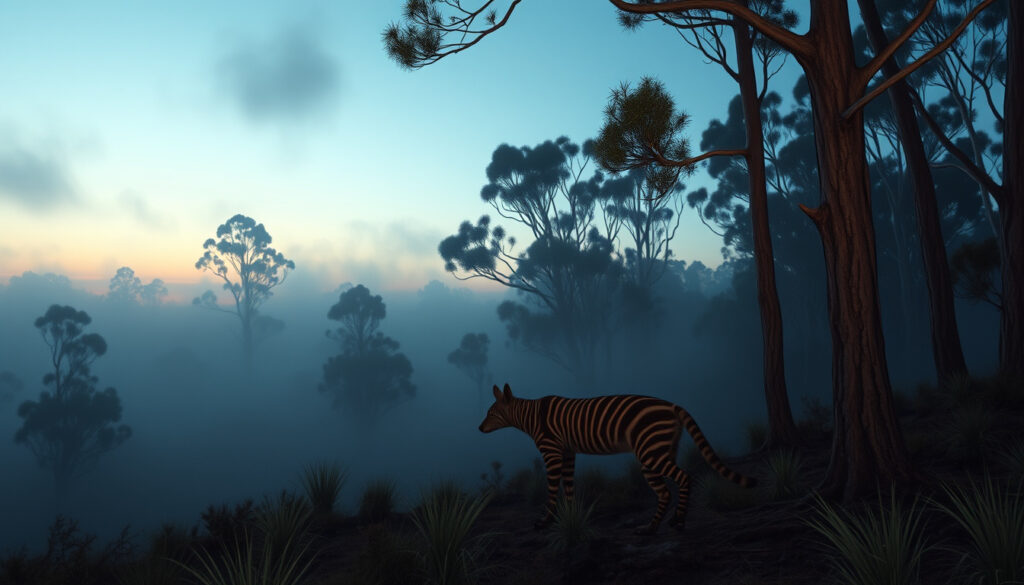
Tasmanian Tiger: Extinction, Sightings, and De-Extinction Efforts
The Tasmanian tiger was a marsupial apex predator driven to extinction by human action, yet its story refuses to stay buried. Officially declared extinct in 1986, the thylacine (Thylacinus cynocephalus) was a carnivorous marsupial that once roamed Australia and New Guinea, with its last known survivor, a captive animal named Benjamin, dying in a Hobart zoo on 7 September 1936.
Scientific name: Thylacinus cynocephalus · Extinction year: 1936 · Last known individual: Benjamin (died 7 September 1936) · Historical range: Tasmania, mainland Australia, Papua New Guinea · Diet: Carnivorous: kangaroos, wallabies, small mammals
Quick snapshot
- The thylacine is officially extinct, with the last known individual dying in captivity on 7 September 1936 (National Museum of Australia).
- It was a carnivorous marsupial, not a tiger or a wolf (Wikipedia).
- Hunting by European settlers was the primary cause of its extinction (National Museum of Australia).
- Whether any thylacines survived in the wild after 1936.
- The exact population size prior to European arrival.
- Whether de-extinction efforts will produce a viable, re-wildable animal.
- Last wild thylacine killed in 1930. (Wikipedia)
- Last captive thylacine (Benjamin) died in 1936. (Wikipedia)
- Officially declared extinct by the IUCN in 1982 (Wikipedia).
- De-extinction research began in earnest in the 2020s (Colossal Biosciences).
- Colossal Biosciences plans to de-extinct the thylacine using gene editing (Colossal Biosciences).
- Ongoing unconfirmed sightings continue to be reported and investigated. (Colossal Biosciences)
The table below presents the key facts about the thylacine in a structured format.
| Attribute | Details |
|---|---|
| Scientific name | Thylacinus cynocephalus |
| Extinction year | 1936 |
| Last known thylacine | Benjamin (died 7 September 1936) |
| Diet | Kangaroos, wallabies, small mammals |
| Size | 100–130 cm long, 50–65 cm tall |
| Weight | 15–30 kg |
| Marsupial | Yes, female had a pouch |
What Is a Tasmanian Tiger?
Thylacine vs Tasmanian Tiger: Same Animal
- The names are interchangeable. “Thylacine” derives from the scientific name, while “Tasmanian tiger” refers to the stripes on its back (Wikipedia).
- It is also called the Tasmanian wolf or marsupial wolf due to its wolf-like appearance (Wikipedia).
- Despite these names, it was a marsupial, not a placental mammal like true tigers or wolves.
Taxonomy and Scientific Name
- Scientific classification: Thylacinus cynocephalus (Wikipedia).
- It was the last living member of the family Thylacinidae, a lineage of carnivorous marsupials (Wikipedia).
- It is a classic example of convergent evolution, developing a wolf-like body plan despite being a marsupial.
Physical Description
- It had a slender, dog-like body with a stiff tail and a pouch that opened backward (Wikipedia).
- Its most distinctive feature was the 13-19 dark stripes across its lower back and tail.
- Adults measured 100-130 cm from nose to tail tip, stood 50-65 cm tall, and weighed 15-30 kg.
The pattern is clear: this was a predator built for stealth and endurance, not speed.
| Specification | Measurement |
|---|---|
| Body length (nose to tail) | 100–130 cm (39–51 in) |
| Shoulder height | 50–65 cm (20–26 in) |
| Weight | 15–30 kg (33–66 lb) |
| Tail length | 50–65 cm (20–26 in) |
| Number of stripes | 13–19 |
| Pouch orientation | Backward-facing |
| Dentition | Carnassial teeth adapted for meat-shearing |
The thylacine wasn’t a single oddity but the endpoint of an entire marsupial lineage that evolved to fill the role of a large carnivore. When it vanished, it took a 10-million-year-old evolutionary branch with it.
What this means: the thylacine’s loss was not just a species extinguished, but an entire evolutionary history erased.
Are Tasmanian Tigers Still Alive in 2026?
Recent Sightings and Evidence
- Despite the official extinction date, unconfirmed sightings have persisted for decades (National Museum of Australia).
- A 2023 study in Science of The Total Environment modeled the extinction window, suggesting a most-likely date in the 1940s to 1970s, with a small possibility of survival into the late 1980s or early 2000s (PubMed).
- The same study notes that the thylacine was extirpated from mainland Australia in the mid-Holocene, leaving Tasmania as the final stronghold (PubMed).
Rock Art Controversy
- In 2024, a rock art discovery in Western Australia sparked debate, as some interpretations suggested the image depicted a thylacine with a stripe pattern, which would imply a much later survival on the mainland than previously thought.
- Other archaeologists argue the art is either ambiguous, an abstract design, or a different animal entirely.
- The debate underscores how powerfully the thylacine functions as a cultural symbol in Australia, where the desire for its survival often clashes with the available evidence.
De-Extinction Efforts
- Colossal Biosciences, a biotechnology company, has announced a project to “de-extinct” the thylacine using CRISPR gene editing on a related marsupial, the fat-tailed dunnart (Colossal Biosciences).
- Dr. Andrew Pask of the University of Melbourne is leading the research, focusing on reconstructing the thylacine genome from preserved specimens (The University of Queensland).
- The project aims to produce a living thylacine-like animal within the next decade, though significant scientific and ethical hurdles remain.
De-extinction without habitat restoration is a conservation mirage. A thylacine in a lab is not a thylacine in the wild. The ecosystem that supported it has changed dramatically since 1936.
Implication: a lab-generated thylacine cannot replicate the ecological role of the original without a restored habitat to return to.
Why Did Tasmanian Tigers Go Extinct?
Hunting by Humans
- The primary cause was intensive hunting by European settlers. A bounty was introduced in 1888, paying £1 per adult thylacine killed (National Museum of Australia).
- Over 2,000 bounties were paid before the program was halted, pushing the species to the brink.
- The thylacine was perceived as a threat to sheep, though the impact of its predation was likely exaggerated.
Habitat Loss and Disease
- Land clearing for agriculture destroyed the thylacine’s habitat and reduced its prey base (National Museum of Australia).
- A distemper-like disease may have affected the population in the early 20th century, further weakening the species.
Competition with Dingoes
- On mainland Australia, the thylacine faced competition from the dingo, a wild dog introduced by humans thousands of years ago (Wikipedia).
- Dingoes never reached Tasmania, which is why the species survived there long after disappearing from the mainland around 3,600 to 3,200 years ago (Wikipedia).
When Was the Last Tasmanian Tiger Seen?
The Last Known Thylacine
- The last known wild thylacine was captured in 1933 by trapper Elias Churchill in the Florentine Valley of Tasmania (National Museum of Australia).
- It was sold to the Hobart Zoo (Beaumaris Zoo) and named Benjamin.
- Benjamin died on 7 September 1936, from exposure after being locked out of its shelter during a cold Tasmanian night (National Museum of Australia).
Sightings Post-1936
- Despite Benjamin’s death, unverified sightings have been reported ever since. The Thylacine Museum catalogues hundreds of reports.
- A 2023 study suggests that the most likely extinction date for the species is in the 1940s-1970s, leaving open the possibility of a small population surviving for a few decades (PubMed).
- The last thylacine displayed outside Australia died at the London Zoo on 9 August 1931 (ZSL).
Official Extinction Date
- The thylacine was officially declared extinct by the International Union for Conservation of Nature (IUCN) in 1982 (Wikipedia).
- It was listed as extinct by the Australian government in 1986 (Australia’s Defining Moments Digital Classroom).
- National Threatened Species Day in Australia has been commemorated on 7 September since 1996, marking the anniversary of Benjamin’s death (Wikipedia).
The extinction timeline below organizes the key events chronologically.
| Period | Event |
|---|---|
| Pre-1800s | Thylacine widespread in Australia, New Guinea, and Tasmania |
| 1800s | European settlement leads to intensive hunting and habitat loss |
| 1888 | Bounty introduced by the Tasmanian government |
| 1930 | Last known wild thylacine killed by Wilfrid Batty |
| 1933 | Last known wild thylacine captured and sold to Hobart Zoo |
| 7 September 1936 | Benjamin dies in Hobart Zoo from exposure |
| 1982 | Declared extinct by the IUCN |
| 1986 | Officially declared extinct by the Australian government |
| 2020s | De-extinction efforts begin at Colossal Biosciences |
| 2024 | Rock art discovery reignites debate about post-1936 survival |
What this reveals: the gap between the death of the last individual and the official declaration of extinction stretched nearly five decades, reflecting the slow machinery of conservation policy.
What Killed the Last Tasmanian Tiger?
Cause of Death of Benjamin
- The last known thylacine, Benjamin, died from exposure to cold weather (National Museum of Australia).
- The night of 6-7 September 1936 saw a sharp temperature drop in Hobart.
- Benjamin was locked out of its sheltered sleeping quarters by the zookeeper, who forgot to bring it inside.
Role of Human Negligence
- Benjamin’s death is widely attributed to human error. The zookeeper’s failure to secure the animal overnight led to its fatal exposure.
- Ironically, the thylacine had been granted protected status by the Tasmanian government just two months earlier, on 10 July 1936 (National Museum of Australia).
- The tragedy underscores the gap between legal protection and effective conservation action.
The species was legally protected, and the last living individual died because of basic human neglect. Paper protections mean nothing without enforcement and awareness.
The implication: Benjamin’s death is a parable of administrative failure, where policy and practice never aligned.
Clarity: What We Know vs. What We Don’t
Confirmed facts
- The thylacine was a carnivorous marsupial (Thylacinus cynocephalus).
- Hunting by European settlers was the primary cause of its extinction.
- Benjamin was the last known individual, dying in 1936.
- It was officially declared extinct in the 1980s.
What’s unclear
- Whether any thylacines survived in the wild after 1936.
- The exact population size prior to European arrival.
- Whether de-extinction efforts will produce a viable, re-wildable animal.
Expert Perspectives
“The thylacine is the perfect candidate for de-extinction. We have the genome, the habitat, and the desire. The question is not whether we can, but whether we should.”
— Dr. Andrew Pask, University of Melbourne, on the feasibility of de-extinction
“The thylacine is a symbol of human-caused extinction. Bringing it back would be a powerful act of restitution, but it must be coupled with a commitment to conserving the species that still remain.”
— Michael Archer, paleontologist, on the significance of the thylacine
The thylacine’s story is a tragedy of human error, but it has also become a story of human ambition. For scientists at Colossal Biosciences and the conservationists watching them, the choice is clear: invest in the resurrection of a single species, or channel those resources into protecting the ones still breathing. The thylacine’s ghost may be our greatest teacher.
For a deeper look into the thylacine’s history and the science behind bringing it back, see this detailed overview of Tasmanian tiger facts and de-extinction.
Frequently asked questions
What is the difference between a thylacine and a Tasmanian devil?
The thylacine (Tasmanian tiger) was a large, striped carnivorous marsupial that is now extinct. The Tasmanian devil is a smaller, stockier carnivorous marsupial that is still alive today, though it is endangered. They are both marsupials, but they belong to different families.
Can the thylacine be brought back?
Colossal Biosciences is actively working on de-extincting the thylacine using CRISPR gene editing. They aim to create a living thylacine-like animal by implanting edited cells into a related species, the fat-tailed dunnart. The project is in its early stages, and significant hurdles remain.
How many thylacines were there?
There is no exact count. The population before European arrival is unknown, but it was likely in the tens of thousands. Over 2,000 bounties were paid in Tasmania between 1888 and 1909, suggesting a significant but already declining population.
What did the thylacine sound like?
A sound recording exists from the 1930s, captured at the Hobart Zoo. It is a short, yapping bark, often described as a “cough” or “woof.” The recording is available online through the National Film and Sound Archive of Australia.
Is the thylacine related to the tiger?
No. Despite its name, the Tasmanian tiger is not related to the tiger (which is a cat). It is a marsupial, meaning it is more closely related to kangaroos, koalas, and wombats than to tigers or wolves. The name comes from the stripes on its back.
Where can I see a thylacine specimen?
Thylacine specimens, including mounted skins, skeletons, and preserved pups in jars, are held in museums around the world. The largest collections are at the Tasmanian Museum and Art Gallery (Hobart), the Australian Museum (Sydney), and the National Museum of Australia (Canberra).
Why is it called Tasmanian tiger?
It is called the Tasmanian tiger because of the 13-19 dark stripes across its lower back and tail, which resemble a tiger’s stripes. It is also called the Tasmanian wolf because of its wolf-like appearance, though it is a marsupial, not a canid.
More related posts
 Wrexham vs Sydney FC: Result, Tour & Ownership Details
 Byron Bay Accommodation – Best Stays for Every Budget
 Schapelle Corby: Arrest, Imprisonment, and Life After Release
 Photo to PDF: Free Converters Online and iPhone Apps
 Best TV Shows 2024 – Top Picks by Critics and Awards
 Debi Mazar: Ethnicity, Madonna Friendship, Career Highlights
 Henry VIII: Wives, Children, Height, Weight, and Legacy
 Toyota Prado Guide: USA Name, Price, vs Land Cruiser
