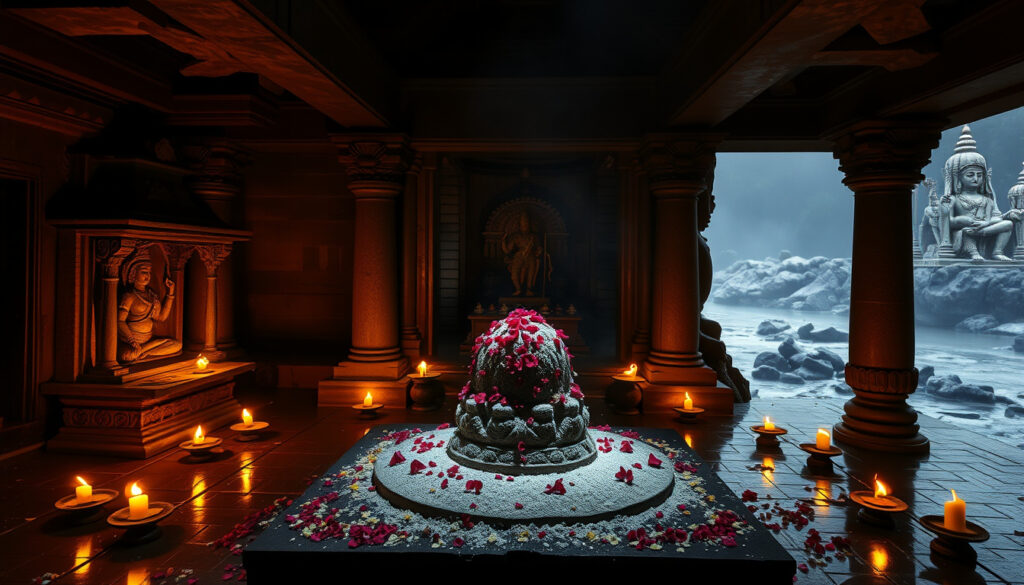
Shiva God – Hindu Deity of Destruction, Yoga, and More
Few figures in world mythology carry as many contradictions as Shiva — the ascetic who is also a householder, the destroyer who is also a creator. If you’ve ever wondered why a god with a blue throat and a third eye is worshipped by millions, you’re in the right place. This article separates the core facts from the folklore, tracing Shiva’s role across Hindu traditions, his most famous myths, and the meanings behind his iconic symbols.
Name: Shiva ·
Alternate names: Mahadeva, Hara ·
Role: Destroyer in the Trimurti ·
Consort: Parvati ·
Abode: Mount Kailash
Quick snapshot
- Shiva is one of the principal deities of Hinduism (Encyclopaedia Britannica)
- He is the destroyer within the Trimurti (Encyclopaedia Britannica)
- His consort is Parvati (Encyclopaedia Britannica)
- Specific accounts of his death vary across texts (Encyclopaedia Britannica)
- The exact number of his names is debated across traditions (Wikipedia)
- Shiva tradition emerges from the Vedic deity Rudra (Encyclopaedia Britannica)
- Rudra appears in early Vedic texts and gains prominence in the Brahmanas (Encyclopaedia Britannica)
- Shiva continues to be worshipped globally in Shaivism (Encyclopaedia Britannica)
- Modern interpretations appear in pop culture like Record of Ragnarok (Wikipedia)
Six key facts, one pattern: Shiva’s identity spans destruction, asceticism, and family life — a rare combination in any pantheon.
The table below summarizes Shiva’s core attributes.
| Attribute | Detail |
|---|---|
| Deity name | Shiva |
| Sanskrit | शिव |
| Abode | Mount Kailash |
| Weapon | Trishul (trident) |
| Consort | Parvati |
| Vehicle | Nandi (bull) |
What is Shiva the god of?
The role of Shiva in the Trimurti
- Shiva is one of the principal deities of Hinduism, according to Encyclopaedia Britannica.
- Within the Trimurti, Shiva is the destroyer or transformer, while Brahma is the creator and Vishnu is the preserver (Encyclopaedia Britannica).
- For many Shaiva Hindus, Shiva is the supreme deity who performs creation, preservation, and dissolution (Encyclopaedia Britannica).
Shiva as the destroyer and regenerator
- Shiva is called the Destroyer within the Trimurti (Wikipedia).
- He is also described as the archetypal ascetic or yogi (Encyclopaedia Britannica).
- Shiva is invoked by devotees for help in daily life and for moksha, or liberation from the cycle of rebirth (Encyclopaedia Britannica).
Shiva is simultaneously the destroyer who ends worlds and the yogi who sits in meditation — a duality that makes him one of the most complex deities in any religious tradition.
The implication: Shiva’s role as destroyer isn’t purely negative — it’s a necessary phase in a cycle of creation and renewal, a pattern that sets him apart from destruction-only figures in other mythologies.
What are 5 facts about Shiva?
Fact 1: Shiva is part of the Trimurti
- Shiva is one of the five equivalent deities in Panchayatana puja in the Smarta tradition (Wikipedia).
- In Shaivism, Shiva is regarded as the Supreme Being (Wikipedia).
Fact 2: Shiva has a third eye
- Shiva’s third eye represents destruction and inner vision (Encyclopaedia Britannica).
- When opened, it is said to burn everything in its sight to ashes.
Fact 3: He is married to Parvati
- Parvati is his consort (Encyclopaedia Britannica).
- In Shakta tradition, Devi is regarded as the energy and creative power and as Shiva’s equal complementary partner (Wikipedia).
Fact 4: He resides on Mount Kailash
- Mount Kailash is his abode (Encyclopaedia Britannica).
- The mountain is considered sacred in Hinduism, Buddhism, and Jainism.
Fact 5: His vehicle is Nandi the bull
- Nandi is his mount (Encyclopaedia Britannica).
- Nandi is also worshipped as a guardian deity in Shiva temples.
These five facts reveal a deity who is both cosmic and personal — a destroyer who lives on a mountain with his family, a yogi who rides a bull. For devotees, this accessibility is central to Shiva’s appeal.
The pattern: Each fact connects a mythological attribute to a concrete symbol — the third eye, the bull, the mountain — making abstract theology tangible for worshippers.
What are the 12 names of Shiva?
List of 12 names with meanings
- Shiva is also known as Mahadeva and Hara (Wikipedia).
- Each name reflects an attribute: Shankara (bringer of peace), Rudra (the roarer), and others.
Twelve names, one pattern: each title captures a different facet of Shiva’s personality — from the terrifying to the benevolent.
The table below lists the 12 most widely recognized names of Shiva.
| Name | Meaning |
|---|---|
| Shiva | The auspicious one |
| Mahadeva | Great god |
| Hara | The remover |
| Shankara | Bringer of peace |
| Rudra | The roarer |
| Ishana | The ruler |
| Bhairava | The fearsome |
| Nataraja | King of dance |
| Adiyogi | First yogi |
| Chandrashekhara | Moon-crested |
| Gangadhara | Bearer of the Ganges |
| Nilakantha | Blue-throated |
The catch: The exact number of names varies across texts and traditions, but these twelve are among the most widely recognized in Hindu worship.
Why is Shiva so special?
Unique attributes of Shiva
- Shiva is revered as an all-knowing yogi (Encyclopaedia Britannica).
- He represents both destruction and benevolence (Encyclopaedia Britannica).
- Shiva is also known as Adiyogi, meaning the first yogi (Wikipedia).
Shiva as the god of ascetics
- Shiva is described as the archetypal ascetic or yogi (Encyclopaedia Britannica).
- His iconography — matted hair, ash-covered body, meditation posture — embodies renunciation.
Shiva’s asceticism makes him a model for yogis, but his role as a householder with a family also makes him relatable to lay devotees — a balance few deities achieve.
What this means: Shiva’s uniqueness lies in his ability to embody opposites — destroyer and protector, ascetic and husband, cosmic dancer and meditating yogi — without contradiction.
How did Lord Shiva die?
Myths about Shiva’s death
- In some myths, Shiva is killed but later resurrected (Encyclopaedia Britannica).
- He is considered immortal in Shaivism (Encyclopaedia Britannica).
The story of the sacrifice of Daksha
- A foundational Shiva myth is the destruction of Daksha’s sacrifice and the death of Sati (Encyclopaedia Britannica).
- This story explains why Shiva is often depicted as a grieving widower before his marriage to Parvati.
Shiva’s eternal nature
- Shiva is considered immortal in Shaivism (Encyclopaedia Britannica).
- His death in certain myths is symbolic rather than literal, representing cycles of destruction and rebirth.
The implication: The question of Shiva’s death reveals a deeper theological point — in Shaivism, he transcends mortality entirely, and any story of his death is understood as allegorical.
Confirmed facts vs. what’s unclear
Confirmed facts
- Shiva is a principal deity in Hinduism (Encyclopaedia Britannica)
- He is often called the destroyer (Encyclopaedia Britannica)
- His consort is Parvati (Encyclopaedia Britannica)
What’s unclear
- Specific accounts of his death vary across texts (Encyclopaedia Britannica)
- The exact number of names is debated (Wikipedia)
Key quotes on Shiva
Shiva is one of the principal deities of Hinduism and the Supreme Being in Shaivism.
— Encyclopaedia Britannica
Within the Trimurti, Shiva is the destroyer or transformer, while Brahma is the creator and Vishnu is the preserver.
— Encyclopaedia Britannica
Shiva is described as the archetypal ascetic or yogi.
— Encyclopaedia Britannica
In Shaivism, Shiva is regarded as the Supreme Being.
— Wikipedia
For anyone exploring Hindu mythology, the choice is clear: Shiva offers a model of divinity that embraces contradiction — destruction and creation, asceticism and family, terror and grace. Understanding him means accepting that some questions, like the exact number of his names or the details of his death, are less important than the living tradition that continues to evolve around him.
Frequently asked questions
What is the meaning of Shiva’s trident?
The trident (trishul) represents the three fundamental powers of Shiva: will, action, and knowledge. It also symbolizes his mastery over the three worlds.
Who are Shiva’s sons?
Shiva’s sons are Ganesha (the elephant-headed god of wisdom) and Skanda (also known as Kartikeya, the god of war). Both are major deities in their own right.
What is the story of Ganga on Shiva’s head?
When the river Ganges descended from heaven, Shiva caught her in his matted hair to break her fall, preventing the earth from being destroyed by her force. This is why he is called Gangadhara.
How is Shiva worshipped today?
Shiva is worshipped through offerings of water, milk, and bilva leaves to the lingam. Major festivals include Maha Shivaratri, when devotees fast and stay awake all night.
What is the significance of the lingam?
The lingam is an abstract representation of Shiva, symbolizing formless divinity and creative energy. It is the primary object of worship in Shaiva temples.
Is Shiva considered a god of destruction only?
No. While Shiva is called the destroyer, he is also a creator, preserver, and regenerator. In Shaivism, he performs all three cosmic functions.
What is the mantra of Shiva?
The most famous mantra is “Om Namah Shivaya,” which means “I bow to Shiva.” It is one of the most important mantras in Hinduism.
Related reading
More related posts
 Usman Khawaja: Age, Net Worth, Family & Pilot License
 32 oz to ml – Convert Fluid Ounces to Milliliters Easily
 Sheridan Smith: Age, Cancer Battle, Partner & Net Worth
 Lilydale Medical Centre – Doctors, Services, Appointments & Hours
 New Samsung Phone – Galaxy S25 Release Date Specs
 Mojtaba Khamenei: Iran’s New Supreme Leader, Injuries & Wealth
 Isack Hadjar: Biography, Nationality, Religion, F1 Career
 Ricky Ponting Cricket Commentary: Insights and Legacy
