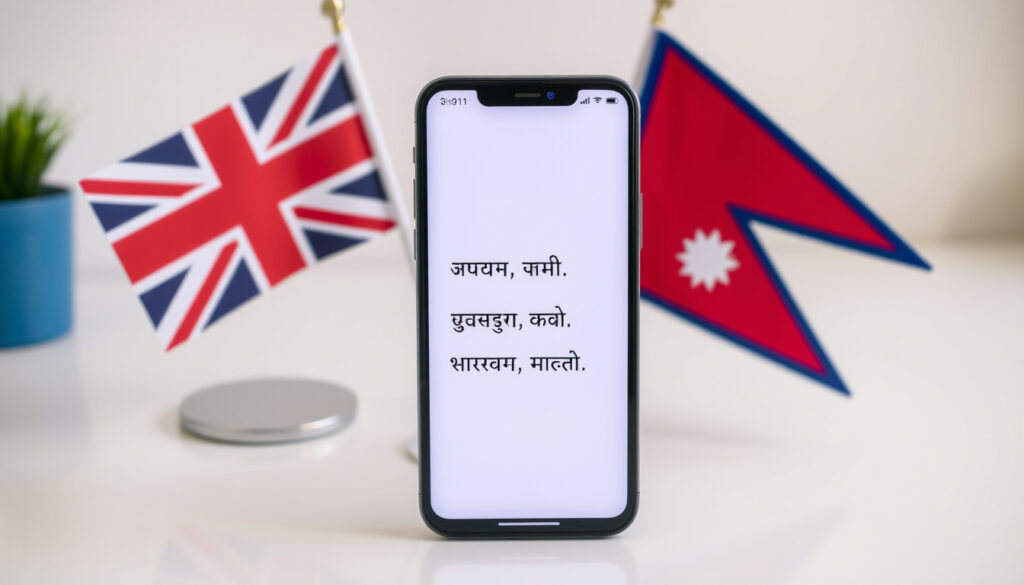
Translating between English and Nepali has become increasingly accessible thanks to a range of free online tools, dedicated mobile apps, and typing solutions designed for the Devanagari script. Whether you need quick phrase translations, detailed dictionary lookups, or voice-enabled communication tools, understanding which resources work best can save time and improve accuracy.
Nepali, an Indo-Aryan language spoken by over 30 million people primarily in Nepal, uses the Devanagari script for writing. This linguistic connection means that English to Nepali translation tools must handle not only vocabulary conversion but also proper character rendering. Machine translation has advanced significantly in recent years, with neural networks powering many of today’s most popular free services.
This guide examines the most reliable free translation tools available, compares their features and limitations, and provides practical advice for achieving the best results when translating between English and Nepali.
Top Free English to Nepali Translation Tools
Several free online platforms have emerged as go-to resources for English to Nepali translation. These tools range from simple paste-and-translate interfaces to sophisticated AI-powered systems capable of handling complex sentences.
Online Translation Platforms
QuillBot offers free translation up to 5,000 characters without advertisements, supporting 52 languages including the English-Nepali pair. The platform uses machine translation algorithms designed to produce fluent grammar and proper accent marks while maintaining natural sentence structure. Users can simply paste text and receive instant translations through a straightforward interface.
Lingvanex provides 100% free translation without requiring account registration. The browser-based tool translates text in real-time as users type, supporting complex sentences that include quotes and abbreviations. This instant-feedback approach proves particularly useful for learning purposes.
Wordvice AI emphasizes high accuracy with minimal errors, featuring a user-friendly design suited for documents and business communications. The platform targets users who need reliable translations for professional contexts.
Easy Nepali Typing operates as the official Google-powered translation tool for the English-Nepali language pair. This platform combines Google’s translation engine with neural network improvements that enhance fluency in output text.
For longer documents, consider breaking text into paragraphs of under 5,000 characters to stay within free tier limits on platforms like QuillBot. Shorter segments also tend to produce more accurate results.
Quick Comparison of Key Features
| Tool | Cost | Character Limit | Special Features |
|---|---|---|---|
| QuillBot | Free | 5,000 per session | Grammar-focused output, no ads |
| Lingvanex | Free | Unlimited | Real-time typing, no sign-up |
| Wordvice AI | Free | Not specified | Business document ready |
| Easy Nepali Typing | Free | Unlimited | Google-powered neural translation |
English to Nepali Dictionaries and Typing Solutions
Beyond simple translation, many users require dedicated dictionary features and keyboard solutions for typing Nepali characters using standard English keyboards.
Dictionary Apps and Features
Mobile apps available through both the App Store and Google Play include built-in dictionaries that provide English-Nepali word meanings, synonyms, and usage examples. These dictionary features prove essential for students, travelers, and business professionals who need precise vocabulary translations rather than full sentence conversion.
The English to Nepali Translator app for iOS offers text and voice conversion along with a comprehensive dictionary containing synonyms and example sentences. This combination makes it particularly suitable for language learners who want to understand not just translations but context and usage patterns.
The Android counterpart from Mobilioninc provides fast text and voice translation with dictionary support. Both apps enable copy-paste functionality, allowing users to transfer translations to other applications seamlessly.
Typing Nepali from English Keyboards
Google Input Tools for Android allows users to type Nepali directly using an English keyboard layout. The system converts keystrokes into Devanagari characters in real-time, eliminating the need for specialized Nepali keyboards.
Easy Nepali Typing Tool supports seamless Nepali typing and translation through cloud-based systems utilizing neural networks for complex phrase handling. The platform handles Devanagari script natively, ensuring accurate character rendering and proper sentence arrangement.
Devanagari script is natively supported across major translation tools, including QuillBot and Lingvanex, for accurate Nepali output and proper sentence organization.
Mobile Translation Apps for English and Nepali
Mobile applications provide the advantage of voice translation and on-the-go access, making them essential tools for travelers and those communicating with Nepali speakers in real-time situations.
Voice Translation Capabilities
Both major mobile translation apps support voice input, allowing users to speak English phrases and receive Nepali translations audibly. This feature proves particularly valuable for travelers navigating Nepal or for emergency communication situations where typing would be impractical.
Vorce App offers an extensive vocabulary database exceeding 150,000 words, making it particularly useful for learning environments and business contexts. Users report that the vocabulary depth rivals professional translation services, which typically charge $50 per hour or more.
Offline Translation Options
Offline functionality remains limited across most primary translation tools, with QuillBot and Lingvanex requiring internet connections for their AI-powered features. Dictionary-focused applications like Vorce imply partial offline capability through stored vocabulary, though complete offline translation support has not been explicitly detailed for major platforms.
Primary tools like QuillBot, Lingvanex, and Easy Nepali Typing require internet connections. If offline access is critical, consider downloading a dedicated dictionary app that stores vocabulary locally on your device.
Translation Accuracy: What to Expect and Limitations
Understanding the accuracy boundaries of machine translation helps users apply these tools appropriately and recognize when human review becomes necessary.
Reported Accuracy Levels
Most translation tools claim accuracy rates between 70-90% for simple text based on AI and machine learning improvements. QuillBot advertises reliable, precise grammar and structure output, positioning itself as better than basic translators. Wordvice and Lingvanex both reference state-of-the-art AI implementations designed to minimize errors and handle complex sentence structures.
Google Translate, powering Easy Nepali Typing, has incorporated neural machine translation improvements since approximately 2016, using zero-shot translation models to enhance fluency. However, no independent head-to-head comparison studies were found in available research, and accuracy claims come primarily from promotional materials rather than verified testing.
Known Limitations
Free translation tiers commonly impose character limits that may interrupt longer translation tasks. Accuracy tends to be highest for simple, straightforward text and decreases significantly when handling idiomatic expressions, cultural references, or highly specialized terminology.
For nuanced communications requiring cultural sensitivity or precise technical language, human review remains recommended despite advances in neural machine translation.
Evolution of English to Nepali Translation Technology
The development of English to Nepali translation tools reflects broader advances in computational linguistics and machine learning.
- 1950s: Formal standardization of Nepali as Nepal’s official language establishes the linguistic foundation for future translation development.
- 2006: Google Translate launches, eventually adding support for Nepali as part of its expanding language portfolio.
- 2010s: Major platforms including Microsoft Translator and dedicated apps add official English-Nepali translation capabilities.
- 2016: Neural machine translation models emerge, significantly improving fluency and context understanding in translation outputs.
- 2020s: Advanced AI implementations enhance accuracy claims across QuillBot, Lingvanex, and Google-powered tools, with continuous improvements through machine learning.
The Unicode Consortium’s Devanagari character charts provide technical documentation for proper script rendering, which modern translation tools leverage to ensure accurate character display.
What Translation Tools Can and Cannot Do
Users benefit from understanding the clear boundaries between what automated translation handles reliably and what requires human intervention.
| Established Capabilities | Remaining Uncertainties |
|---|---|
| Simple sentence translation with reasonable accuracy | Precise accuracy percentages for specific text types |
| Real-time translation as users type | Full offline functionality across all platforms |
| Devanagari script rendering | Consistent handling of regional dialects |
| Voice input and audio output in many apps | Long-term vocabulary update frequency |
| Built-in dictionaries with synonyms | User review data for accuracy verification |
| Free tier availability across major platforms | Future pricing structure changes |
Nepali Language Context and Script Basics
Nepali belongs to the Indo-Aryan branch of Indo-European languages, closely related to Hindi and other North Indian languages. The language serves as the official tongue of Nepal and is spoken by over 30 million native speakers, with significant diaspora communities in India, Bhutan, and the United Kingdom.
The Devanagari script used for writing Nepali consists of 33 base characters representing vowels and consonants, with additional diacritical marks for grammatical precision. Translation tools must handle not only lexical conversion but also proper character mapping and sentence structure adaptation to maintain readability in Nepali output.
For travelers and business professionals, common translation needs include restaurant menus, transportation schedules, medical information, and basic conversational phrases. Machine translation handles these practical scenarios reasonably well, though nuance may be lost in sensitive situations.
Evaluating Translation Tool Sources and Credibility
The credibility of English to Nepali translation tools varies based on their technical foundations, update frequency, and user support structures.
Translation tools leverage machine translation advances including neural networks, with many claiming improvements since 2016 through zero-shot translation models developed by major technology companies.
Google Translate draws authority from Google’s computational linguistics research and continuous model training. QuillBot, Lingvanex, and Wordvice AI rely on proprietary AI implementations with varying levels of documented methodology. Dictionary-focused tools like Shabdkosh utilize user contributions alongside curated vocabulary databases.
The Unicode Consortium provides authoritative technical documentation for Devanagari script handling, which reputable translation tools follow to ensure cross-platform character consistency. Government resources from Nepal, including official language documentation, provide additional verification points for specialized terminology.
Summary and Recommendations
Free English to Nepali translation tools have reached sufficient maturity for everyday communication needs, travel assistance, and basic business correspondence. QuillBot, Lingvanex, and Google-powered platforms like Easy Nepali Typing offer reliable results for straightforward text, while mobile apps provide voice-enabled solutions for real-time conversations.
For language learners and professionals requiring deeper vocabulary access, dedicated dictionary apps including the iOS and Android translator applications offer enhanced features with synonyms and usage examples. Users should expect 70-90% accuracy for simple text and plan for human review when handling nuanced, culturally sensitive, or highly specialized content.
Exploring related language tools can expand translation capabilities. Hindi, for instance, shares significant vocabulary and grammatical structures with Nepali, making resources for Hindi translation potentially useful for advanced Nepali work.
Frequently Asked Questions
How accurate is Google Translate for English to Nepali?
Google Translate achieves 70-90% accuracy for simple text according to promotional materials. Accuracy decreases for idiomatic expressions, cultural references, and complex grammatical structures. Human review is recommended for important documents.
Can I translate English to Nepali offline?
Offline access remains limited. Most primary tools require internet connections. Dictionary-focused apps like Vorce may offer partial offline functionality through stored vocabulary, though full translation capabilities typically require online access.
What is the best free English to Nepali translator?
Multiple tools rank highly for different purposes. QuillBot offers ad-free translation with grammar focus. Lingvanex provides unlimited characters without sign-up. Easy Nepali Typing uses Google-powered neural translation. The best choice depends on specific needs like voice support or vocabulary depth.
How do I type Nepali using an English keyboard?
Google Input Tools converts English keystrokes into Devanagari characters in real-time. Easy Nepali Typing also offers cloud-based typing solutions. Simply install the tool, select Nepali as the input language, and type normally to produce Nepali script.
Are there mobile apps for English to Nepali translation?
Yes, apps like English to Nepali Translator for iOS and English Nepali Translator for Android offer text and voice translation with built-in dictionaries. Voice features make these particularly useful for travelers and real-time conversations.
What character limit should I expect with free translation tools?
QuillBot limits free users to 5,000 characters per session. Lingvanex and Easy Nepali Typing do not specify character limits for free use. For longer documents, consider breaking text into smaller segments to stay within limits.
How has Nepali translation technology improved?
Neural machine translation since 2016 has significantly improved fluency and context understanding. Platforms like Google Translate and QuillBot now produce more natural-sounding output compared to earlier rule-based translation systems.
Can I trust machine translation for business documents?
Machine translation provides a useful starting point for business documents but requires human review for accuracy, tone, and cultural appropriateness. Professional translation services offer higher accuracy at approximately $50 per hour, which may be justified for contracts or official communications.
For additional language resources, explore our comprehensive translation tools guide covering multiple language pairs and use cases.