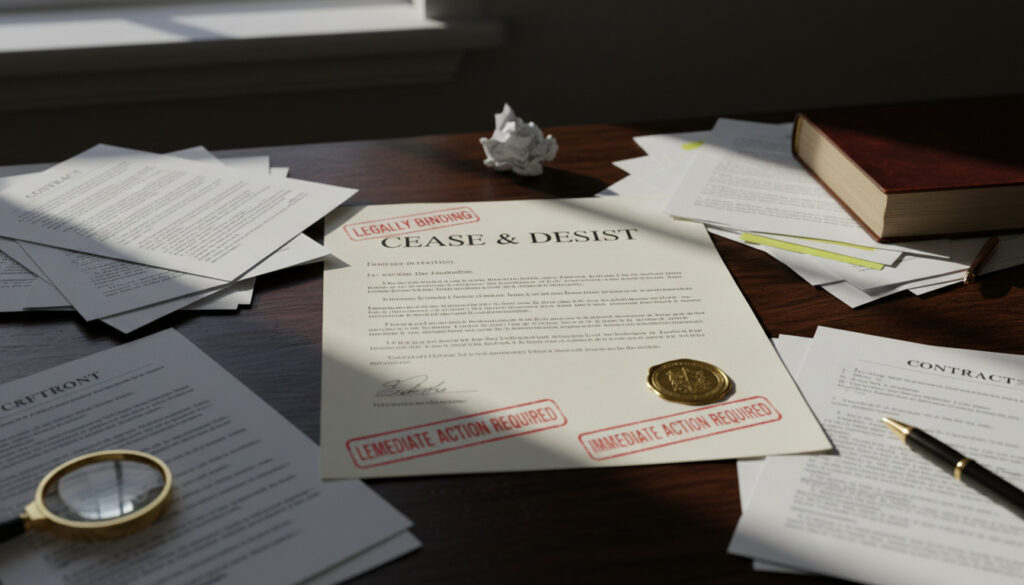
Cease and Desist – Binding Status, Response Guide
A cease and desist letter is a formal notice demanding that a recipient stop specific activities, such as trademark infringement, harassment, or contract breaches, with explicit threats of further legal action if ignored. According to Davis Business Law, these documents serve as preemptive warnings designed to resolve disputes without court involvement, though they carry significant strategic weight in subsequent litigation.
Unlike court orders, these letters lack inherent legal enforceability. Arapacke Law notes that their power derives primarily from signaling intent to escalate to lawsuits, injunctions, or temporary restraining orders. Recipients who disregard these warnings risk strengthening the sender’s legal position by providing evidence of willful infringement.
The following guide examines the binding nature of these demands, appropriate response protocols, and drafting strategies based on current legal standards. Whether you are analyzing employment benefits like What Is Leave Loading – Eligibility, Calculation & Payout Guide or navigating intellectual property disputes, understanding these mechanisms proves essential for protecting legal rights.
What Is a Cease and Desist Letter?
Formal Legal Demand
Official notice requiring immediate cessation of specified activities violating rights or laws.
Non-Binding Warning
Lacks court enforcement power but signals imminent litigation if ignored.
Common Applications
Frequently deployed for trademark infringement, harassment, defamation, and contract breaches.
Drafting Options
Self-drafting is possible, though attorney-prepared letters carry greater evidentiary weight.
Key Characteristics
- Serves as formal evidence of notice, crucial for proving willful infringement in court
- Requires specific identification of violations, supporting evidence, and legal basis to be effective
- Certified mail delivery with return receipt creates verifiable proof of receipt
- Attorney-drafted correspondence significantly increases compliance rates
- Ignored letters often result in escalated litigation with higher damage awards
- Federal laws like the Lanham Act frequently provide the legal basis for trademark-related demands
| Aspect | Details |
|---|---|
| Legal Status | Advisory notice, not legally enforceable without court order |
| Typical Sender | Business entities, intellectual property holders, attorneys |
| Common Targets | Unauthorized trademark use, defamation, harassment, contract violations |
| Response Deadline | Typically 7 to 30 days from receipt |
| Drafting Cost | $500 to $2,000 for attorney preparation |
| Delivery Method | Certified mail with return receipt recommended |
| Litigation Cost | $10,000 to $500,000+ if escalated to court |
| Primary Legal Basis | Lanham Act for trademarks; state laws for defamation/harassment |
Is a Cease and Desist Letter Legally Binding?
Ignition Law clarifies that cease and desist letters lack the force of a court order or legally enforceable contract. They cannot compel action independently. Instead, their effectiveness stems from the implicit threat of costly litigation, including potential lawsuits, permanent injunctions, or temporary restraining orders.
Legal Force and Limitations
Courts recognize these documents as strategic communications rather than binding decrees. California State University research confirms that while non-binding, such letters serve as admissible evidence demonstrating that the recipient had formal notice of alleged violations.
Risks of Ignoring the Demand
Legal analysts at Davis Business Law warn that ignored letters invite immediate litigation. Courts interpret non-response as evidence of willful infringement, potentially justifying enhanced damages—particularly in trademark cases where willful violations carry statutory penalties.
Courts view ignored cease and desist letters as proof of willful infringement, which can significantly increase liability and damage awards in subsequent litigation.
What Should You Do If You Receive a Cease and Desist Letter?
Receiving such correspondence requires immediate attention. Woods Talbot & Streisand emphasize that ignoring the letter creates damaging evidence of notice, while hasty responses without legal counsel risk admitting liability inadvertently.
Immediate Assessment Steps
Recipients should carefully document the receipt date and examine all stated deadlines. Arapacke Law recommends comparing the alleged violations against internal records and gathering all relevant contracts, communications, and evidence before formulating any response.
Legal Consultation and Response Strategy
Engaging qualified legal counsel before replying prevents strategic errors. Response options include direct compliance with demands, negotiating a settlement agreement, or denying the allegations with supporting counter-evidence. Each approach carries distinct risks regarding cost exposure and litigation probability.
Similar to monitoring Federal Election Australia – 2025 Results Timeline for critical deadlines, tracking response timelines in legal matters prevents forfeiture of rights through procedural default.
How Do You Write and Send a Cease and Desist Letter?
Effective drafting requires balancing firmness with factual accuracy to avoid counterclaims for harassment or defamation. Underberg Glazer Law advises against aggressive threats lacking legal merit, as these undermine credibility and may expose the sender to liability.
Essential Components
Valid letters must include: clear identification of all parties; detailed descriptions of infringing conduct with photographic or documentary evidence; specific legal rights violated; precise demands with realistic deadlines (typically 7-14 days); explicit consequences of non-compliance; and contact information for negotiation.
Begin with letterhead and date, followed by recipient identification. State your representation, describe the specific infringement with reference numbers, cite applicable law (such as the Lanham Act for trademark issues), demand immediate cessation by a specific date, and specify that non-compliance will result in immediate lawsuit filing for damages and injunctive relief.
Delivery and Cost Considerations
Certified mail with return receipt provides court-admissible proof of delivery. Cost estimates range from $500 to $2,000 for attorney-drafted letters, while complex litigation can escalate to $100,000 or more. Attorney involvement significantly increases the document’s persuasive value and demonstrates serious intent.
Letters drafted by licensed attorneys carry substantially more weight than self-drafted versions, often prompting immediate compliance without further legal action.
What Is the Typical Timeline After Sending or Receiving a Letter?
- Day 0: Letter dispatched via certified mail with return receipt requested to establish legal notice
- Days 1-14: Recipient reviews allegations, gathers evidence, and consults legal counsel regarding merit
- Days 15-30: Negotiation period where parties may settle, or recipient provides written response complying or disputing claims
- Day 30+: Sender may file lawsuit for damages or injunctive relief if no satisfactory resolution occurs
- Months 6-24: Litigation proceeds through discovery, motions, and potential trial if case is not dismissed or settled
Source: Davis Business Law; Arapacke Law
What Is Certain and Uncertain About These Legal Notices?
| Established Facts | Uncertain Variables |
|---|---|
| Letters create formal evidence of notice that courts recognize in willful infringement determinations | Whether specific claims have sufficient merit to survive motion to dismiss without full litigation |
| Attorney involvement significantly increases compliance rates and demonstrates serious legal intent | Exact timeline to resolution, as settlements may occur immediately or proceed through multi-year litigation |
| State laws vary regarding specific harassment and defamation statutes, with no uniform federal mandate | Whether the sender will actually escalate to costly litigation or if the letter represents a strategic bluff |
What Is the Legal Context and Historical Background?
Cease and desist mechanisms evolved as preliminary dispute resolution tools within intellectual property law, particularly under federal trademark protections like the Lanham Act. Texas legal research indicates varying state-level interpretations, with jurisdictions like California formally classifying these letters as non-binding warnings usable solely as evidence.
Strategically, attorneys utilize these notices to secure rapid resolution before litigation costs accumulate. Academic analysis suggests that well-documented demands with strong evidentiary support deter continued infringement more effectively than immediate court filings, preserving business relationships while protecting rights.
What Do Legal Experts Recommend?
Practicing attorneys emphasize evidence-based drafting over aggressive rhetoric. Davis Business Law advises senders to avoid baseless claims that risk exposing them to harassment countersuits, while Woods Talbot & Streisand stress that recipients should seek counsel immediately upon receipt.
Professional consensus indicates that these letters function most effectively as tactical instruments for early settlement rather than intimidation devices. The underlying validity of claims ultimately determines outcomes, not the forcefulness of the initial demand language.
What Are the Essential Takeaways?
Cease and desist letters serve as strategic, non-binding warnings that create formal evidence of notice while threatening escalation to costly litigation. Effectiveness depends entirely on the underlying legal merit of claims and the professionalism of presentation—attorney-drafted letters consistently achieve higher compliance rates than self-drafted alternatives. Recipients must respond thoughtfully rather than ignore these demands, as courts interpret silence as evidence of willful infringement warranting enhanced damages. Whether addressing employment matters like What Is Leave Loading – Eligibility, Calculation & Payout Guide or complex intellectual property disputes, proper legal documentation and timely response remain critical for protecting rights.
Frequently Asked Questions
Who can send a cease and desist letter?
Any individual, business entity, or legal representative may issue these notices. Common senders include trademark holders addressing infringement, businesses enforcing contract terms, or individuals responding to harassment. While self-drafting is permitted, attorney representation significantly increases the document’s credibility.
Can you send a cease and desist letter without an attorney?
Self-drafting is legally permissible but carries risks. Letters lacking proper legal citations or making unsupported threats may undermine your position or expose you to counterclaims. Attorney-drafted correspondence demonstrates serious intent and typically achieves faster compliance.
How much does a cease and desist letter cost?
Attorney-drafted letters typically range from $500 to $2,000 depending on complexity. If the dispute escalates to litigation, costs can reach $10,000 to $500,000 or more. Recipients facing defense costs should consider early settlement to avoid protracted expenses.
What are common examples of cease and desist letters?
Common applications include demands to stop unauthorized trademark use on counterfeit goods, cease defamatory statements harming business reputation, end harassing communications or stalking behaviors, and remedy breach of contract violations. Each requires specific evidence supporting the alleged violation.
Is a cease and desist letter the same as a lawsuit?
No. A C&D letter is a preliminary warning sent before litigation, while a lawsuit involves formal court filing. The letter attempts resolution without judicial intervention; lawsuits seek binding court orders and damages. Many disputes resolve at the letter stage without ever reaching court.
More related posts
 Hamad Medjedovic: Biography, Ranking, Height & More
 Charlotte Rampling: Biography, Movies & Iconic Career
 Paris Ow-Yang: Biography, Net Worth & Property Dispute
 Stephen King: Sobriety, Accident, and Family Life
 Jesse Eisenberg: Diagnosis, Family, and Why He Donated a Kidney
 Jason Alexander: Biography, Net Worth, Wife, and Seinfeld Exit
 Anil Kapoor Health, Family & Net Worth: Facts vs Rumors
 Brenden Abbott: Where Is the Postcard Bandit Now
