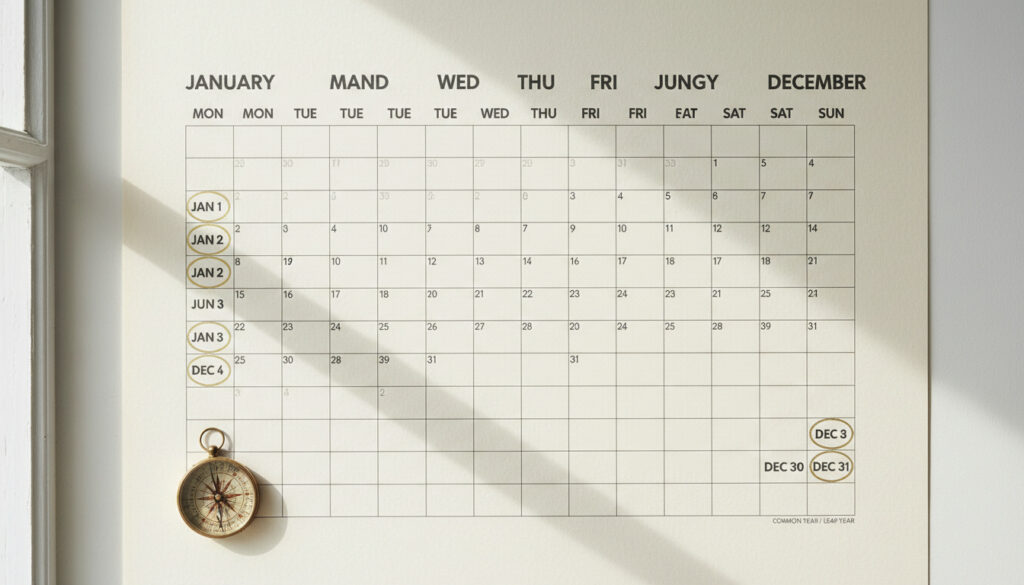
Weeks in a Year – Exact Count for Common and Leap Years
A standard calendar year contains more than the round figure typically quoted. Precise mathematical division reveals that 365-day years hold exactly 52 full weeks plus one additional day, while leap years accumulate 52 weeks plus two days.
The discrepancy between simple multiplication and astronomical reality creates ongoing challenges for payroll systems, fiscal planning, and scheduling applications that rely on whole-week increments. Understanding the exact fractional remainders helps prevent cumulative errors in long-term projections.
How Many Weeks Are in a Year?
The calculation of 365 days divided by seven yields 52.142857 weeks. This translates practically to 52 complete seven-day cycles with one day remaining.
Calendar systems align human activity with Earth’s orbit, yet seven-day cycles divide unevenly into annual periods. This misalignment necessitates careful tracking of remainder days.
Key Facts About Annual Week Counts
- Remainder days accumulate annually, shifting dates forward by one or two days each year
- Payroll calculations using simple 52-week multipliers create slight underpayments over time
- ISO standards officially recognize both 52-week and 53-week years depending on starting weekdays
- Fiscal planning requires choosing between 52-week or 53-week accounting frameworks
- The fraction 52.142857 represents an infinite decimal repeating the sequence 142857
- Calendar drift cycles every 400 years due to irregular leap year patterns
Precise Measurements
| Metric | Common Year | Leap Year |
|---|---|---|
| Total days | 365 | 366 |
| Exact weeks | 52.142857 | 52.285714 |
| Full weeks + remainder | 52 weeks + 1 day | 52 weeks + 2 days |
| Exact fraction | 52 + 1/7 | 52 + 2/7 |
| Four-year total | 208 weeks + 5 days (1,461 days) | |
| 2026 calculation | 52 weeks + 1 day | N/A |
How Many Weeks in a Leap Year?
Leap years contain 366 days, which divides into exactly 52 weeks plus two additional days. This creates a 52.285714-week total that frequently rounds to 52.29 weeks in planning documents.
The 366-Day Division
When February contains 29 days, the annual total shifts from 365 to 366. Division by seven yields fifty-two full weeks with a two-day remainder. These extra days ensure that seasonal markers remain aligned with astronomical cycles over centuries.
The additional day in leap years adds exactly 0.142857 weeks to the baseline calculation. Over a four-year cycle including one leap year, the total remainder becomes five days (1+1+1+2).
Gregorian Calendar Rules
Leap years occur every four years under current standards, except for century years not divisible by 400. Thus, 1700, 1800, and 1900 were not leap years, while 2000 was. This exception fine-tunes the calendar to match Earth’s actual orbital period of approximately 365.2425 days.
Why Isn’t a Year Exactly 52 Weeks?
The mismatch stems from prime indivisibility. Seven-day weeks divide into 364 days evenly (52 × 7 = 364), but astronomical years exceed this by one or two days.
The Mathematical Remainder
These remainders cause the calendar to shift by one or two days annually relative to the week cycle. Over time, this drift occasionally produces a 53-week year every five to six years when the extra days align to complete an additional seven-day cycle.
Cumulative Calendar Effects
Without leap year corrections, the one-day annual surpluses would accumulate to approximately 30 days per century. The Gregorian reform prevents seasonal drift, yet the seven-day cycle remains mathematically incompatible with 365 and 366, ensuring perpetual fractional remainders.
How to Calculate Weeks in Any Year?
Precise calculation requires dividing the total days by seven and handling remainders separately. For common years, divide 365 by 7 to obtain 52 with a remainder of 1. For leap years, 366 divided by 7 yields 52 with a remainder of 2.
Simple Division Method
Start with the annual day count. Perform integer division by seven to obtain complete weeks. The modulus operation reveals remaining days. This method works for any Gregorian year, including fiscal periods that may span 52 or 53 weeks.
When calculating payroll or project timelines, use 52.14 weeks for common years and 52.29 weeks for leap years to minimize rounding errors over multi-month periods.
ISO Week Numbering Variations
ISO 8601 standards define weeks as starting on Monday, with the first week containing the first Thursday of the year. This rule occasionally creates 53-week years regardless of the 365-day remainder, particularly when January 1 falls on Friday, Saturday, or Sunday.
Organizations frequently operate on 52-week or 53-week fiscal years ending on specific dates like March 31 or December 31. These accounting periods do not align with Gregorian week calculations and require separate tracking systems.
How Did Calendar Standards Evolve?
- 45 BCE: Julius Caesar establishes the Julian calendar, averaging 365.25 days annually through simple four-year leap cycles.
- 1582: Pope Gregory XIII introduces the Gregorian reform, skipping ten days (October 4 followed October 15) to correct accumulated drift and refining leap year rules to exclude certain century years.
- 1920s-1988: The International Organization for Standardization develops ISO 8601, establishing Monday as the first day of the week and formalizing 52/53-week year definitions for business use.
- Present: The Gregorian calendar maintains the 365/366-day structure with precise leap year exceptions, while digital systems track fractional weeks to microsecond precision.
What Is Definite vs. Variable?
Established Facts
- 365 days equals exactly 52 weeks plus 1 day
- 366 days equals exactly 52 weeks plus 2 days
- Gregorian leap years occur every 4 years (with century exceptions)
- The fraction 365/7 repeats infinitely as 52.142857142857…
Variable Elements
- Specific fiscal year-end dates vary by organization
- ISO 53-week year frequency depends on January 1 weekday
- Payroll processing schedules differ between companies
- Calendar applications may round decimals differently
Why Does This Matter for Scheduling?
Business operations relying on weekly cycles face accumulated discrepancies when using simple 52-week multipliers. Human resources departments calculating annual salaries must account for the extra day to prevent systematic underpayment.
The July 2025 Calendar – Free Printable PDF with Holidays demonstrates how mid-year dates shift within weekly cycles, affecting project planning and holiday scheduling. Organizations tracking time-sensitive deliverables must verify whether their planning software accounts for 52.14-week fractions or rounds to whole numbers.
What Do Time Authorities Confirm?
While NIST maintains precise UTC standards for timekeeping, the division of days into weeks falls under calendar conventions rather than physical constants. The National Institute of Standards and Technology focuses on atomic time standards and leap seconds, leaving week calculations to mathematical definitions.
The Gregorian calendar’s 365-day year divides mathematically into 52 weeks with a remainder of one day, creating a perpetual offset that shifts annual dates through weekly cycles.
Mathematical consensus from calendar calculation standards
How Should You Apply This Information?
Use 52.14 weeks for common years and 52.29 weeks for leap years when calculating pro-rata payments or long-term interest. Verify whether your organization follows calendar years or 52-week fiscal periods like those referenced in leave loading calculations. For precise scheduling, account for both the mathematical remainders and the specific ISO week numbering system your industry employs.
Common Questions
Is there exactly 52 weeks in a year?
No. Common years contain 52 weeks plus one additional day. Leap years contain 52 weeks plus two days. The exact figures are 52.142857 and 52.285714 weeks respectively.
Why do some years have 53 weeks?
Under ISO 8601 standards, years where January 1 falls on Friday, Saturday, or Sunday may contain 53 weeks. This occurs when the year contains at least four days of the new year within the first week.
How many weeks will 2026 contain?
The year 2026 contains exactly 52 weeks and one day, totaling 365 days. It is not a leap year.
Do fiscal years always match calendar weeks?
No. Organizations may operate 52-week or 53-week fiscal years ending on specific dates like March 31 or December 31, independent of the solar calendar day count.
How does this affect bi-weekly payroll?
Bi-weekly schedules typically yield 26 pay periods annually. However, occasional 27-pay-period years occur when the calendar alignments create an extra pay cycle within the fiscal year.
More related posts
 Brenden Abbott: Where Is the Postcard Bandit Now
 Mark Wahlberg Biography: Family, Net Worth, and Latest News
 What Is Scott Pape Doing Now? His Net Worth, Life, and Latest Updates
 July 2025 Calendar – Free Printable PDF with Holidays
 RBA Interest Rate Cut – Two Hikes Reverse 2025 Easing
 Cameron Ciraldo: Biography, Age, Coaching Career, and Facts
 Holly Wheeler Recast: Why the Actress Changed in Season 5
 Ron Weasley: Biography, Family, and Key Facts
